Editorial Note: This article explores cultural lifestyle inspiration in an editorial way. It does not claim to represent every woman, country, region, or personal experience. WorldsLadies avoids stereotypes and presents these ideas as gentle, adaptable lifestyle reflections.
In a compact Bucharest apartment, Romanian women lifestyle is not presented as a national style. The useful question is how a home can hold memory while still serving work, meals, storage and rest. Recent interiors in the city answer through movable boundaries, locally made joinery and objects whose materials remain visible instead of being reduced to folk decoration.
This feature follows that narrow setting: contemporary rooms and public interiors in Bucharest, with brief comparisons to a restored townhouse in Brăila and museum collections that preserve objects from several Romanian regions. Those examples belong to different dates, building types and communities, so they are not combined into one picture of Romanian domestic life.
Here, Romanian women lifestyle stays within a narrow setting where Bucharest interior design, home rituals and Romanian craft meet at room scale. A curtain can change the use of a room; a wooden table can move between laptop, coffee and supper; porcelain can alter the quality of light. These are design decisions documented in particular projects, not habits assigned to Romanian women or to households across the country.
Key Takeaway: In contemporary Bucharest interiors, heritage works best as a material decision that supports movement, light and daily use.
Romanian Women Lifestyle in a Bucharest Apartment
Within this specific city apartment, Romanian women lifestyle is documented through two inserted volumes in an eighty-square-metre Bucharest plan. A green entrance box compresses the first view before the living room opens toward the crown of a mature tree; a wooden box marks the route to the sleeping area. The project turns arrival into a sequence, so the flat does not need a corridor lined with decorative objects to create character.
The most adaptable element is less visible. An acoustic curtain closes off a room that can work as an office, dressing area or bedroom, while custom furniture made with local carpenters answers the apartment’s difficult geometry. In a city home where one room may carry several jobs during the day, that kind of boundary creates order without pretending that every activity needs a permanent room.
A reader working with a smaller rental can treat Romanian women lifestyle here as a narrow Bucharest design setting, keeping the principle while changing the construction. A ceiling track, folding screen or freestanding shelf can create a threshold without copying the green and wood boxes. What matters in the Bucharest project is the sequence between entrance, shared room and private area, together with the way the curtain can be opened again when evening use changes.
Wood and Porcelain at the Scale of a Room
Wood appears in the apartment as fitted joinery, while a museum collection in Bucharest shows why the material should not be treated as one national finish. Its collection distinguishes furniture, tools and household vessels by function and by regional differences in form, carving and wood species. A walnut surface, a fir vessel and an incised box carry different uses and collection histories; placing them under a single “Romanian rustic” label would erase the information the museum preserves.
Porcelain offers another scale. In a 2019 profile of Bucharest ceramicist Andreea Braescu, Architectural Digest described light fittings assembled from individually made porcelain leaves in her studio. Their placement responds to a particular room and to the direction of light. The useful home lesson is therefore technical: one crafted object can shape illumination and shadow more effectively than a shelf crowded with unconnected heritage motifs.
The Table Between Work and Evening
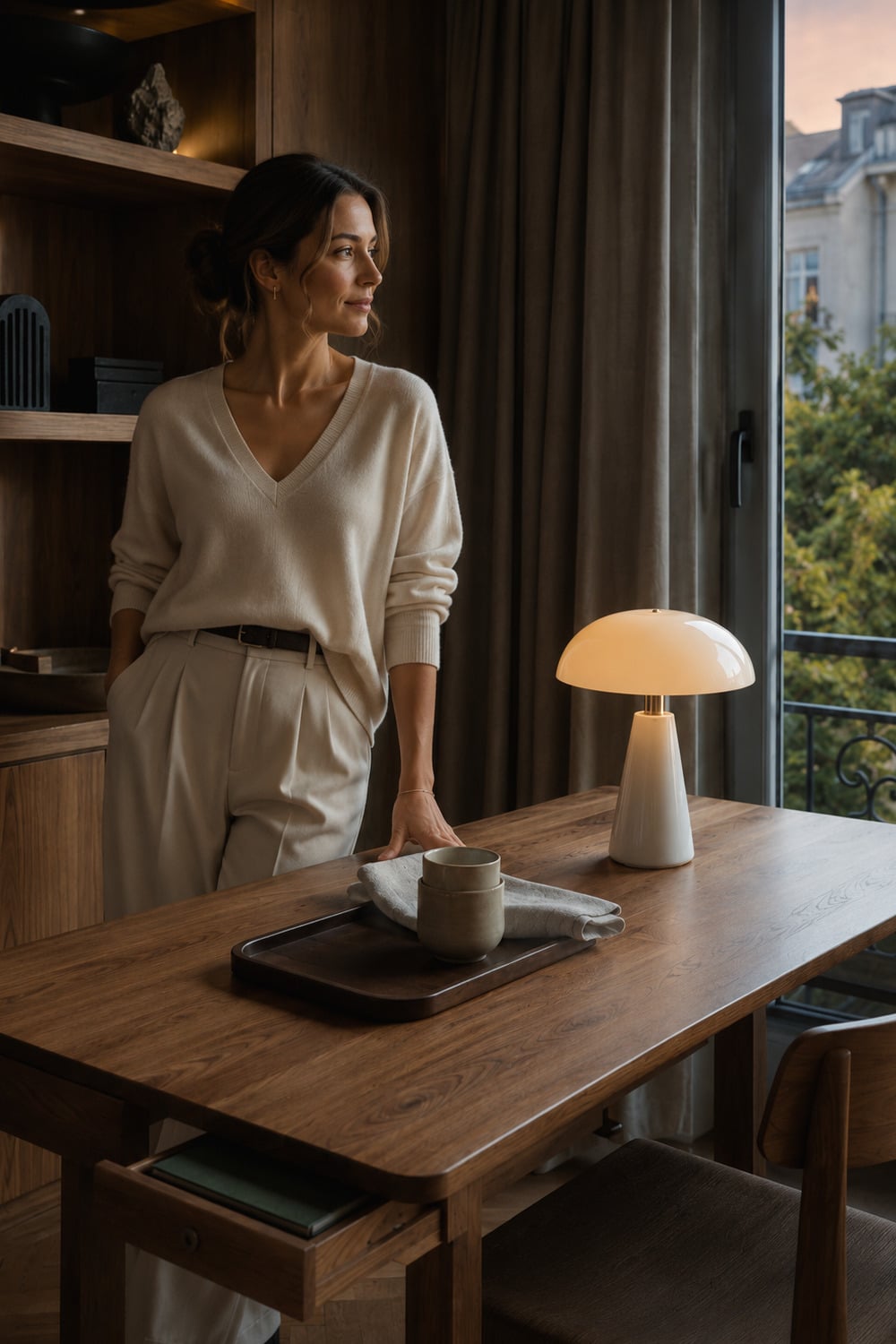
In many Bucharest apartments, the table must earn its floor area. Within this city context, Romanian women lifestyle does not establish how residents across Bucharest live; the documented projects instead show a recurring design problem behind flexible apartment routines: a single surface may support remote work, a quick coffee, food preparation and an evening meal. The ritual comes from resetting the surface between tasks, not from staging a permanent display.
A workable sequence begins with storage close enough to clear the table quickly. A shallow drawer can hold chargers and notebooks; a tray can gather a cup, carafe and small bowl; folded linen can stay in one accessible stack. Using wood, ceramic and cloth together makes sense when each object has a job. The arrangement becomes specific to the room through its window light, available storage and the distance between kitchen and table.
WorldsLadies readers comparing social settings can place this Bucharest table beside the hospitality questions raised in Lebanese women lifestyle and the composed city references in Serbian women lifestyle. The comparison is most useful at the level of timing, seating and material choices, because each linked article begins from a different place and set of routines.
Lipscani Reuse Without Nostalgia as Decor
A 2012 interior report on Papiota Cafe in Bucharest’s Lipscani area recorded steel shelves, yarn spools, salvaged industrial lights and sewing machines from Romanian manufacturing companies. Chairs from one founder’s grandmother and tables shaped like ironing boards made the reuse personal to that café. The example is dated and commercial; in this narrow setting, Romanian women lifestyle refers only to how an object’s former task can guide its new function instead of serving as anonymous vintage atmosphere.
At home, that approach asks for restraint. One repaired work lamp beside a desk can carry more meaning than several factory objects bought only for appearance. A sewing box can organise cables; a sturdy old stool can become bedside storage; a family chair can be reupholstered for the dimensions of the present room. The Bucharest café is not a template for Lipscani today, yet its method keeps memory attached to use.
The same check prevents heritage from becoming a costume for the room. Before adding an old object, identify where it came from, what it did and whether its scale suits the apartment. When that information is unknown, describe it simply as a vintage or second-hand piece without assigning Romanian origin, symbolism or continuity.
A second-hand object also needs a stopping point. In the Papiota interior, spools, lamps, machines and family furniture were tied to one industrial theme; adding unrelated motifs would have weakened that connection. For a Bucharest flat, a narrow group works better: one task lamp, one wooden chair and one storage object, all positioned where their former construction still helps. The room then reads as lived-in reuse, not as a display assembled from anonymous flea-market signs.
What Public Interiors Add to the Home
Bucharest’s public interiors can sharpen domestic decisions because they handle light, circulation and gathering at a larger scale. In this city context, Romanian women lifestyle remains focused on those design questions. At Milló, a restaurant opened in an office building, a 2025 Wallpaper report noted terrazzo inlays that answer the façade’s geometry, lacquered wood panelling and lighting that changes through the day. Those elements belong to a restaurant, but the relationship between surface and architecture can be reduced for a home.
A small apartment does not need marble, a sculptural ceiling or restaurant drama. It can repeat one line from the building in a rug border, use a warmer lamp near the dining end of the room, or choose rounded furniture where circulation is tight. The adaptation stays connected to the Bucharest example because it begins with the same functional questions: how people enter, where they pause and how light changes from midday to evening.
Romanian Design Week’s 2025 programme adds another contemporary layer. Its Bucharest exhibitions brought architecture, textiles, graphic design and product design into multiple city venues, including projects on sustainable Bucharest and the textile industry. That programme does not define a shared household aesthetic. It does show that heritage materials can sit beside urban regeneration, current production and new display methods outside historical rooms.
Regional Objects Need Their Museum Labels
The museum collection in Bucharest is especially useful as a boundary for this specific treatment of Romanian women lifestyle and Romanian heritage materials. It records objects from Oltenia, Wallachia, Banat, Transylvania, Dobrogea and other areas, often with distinct materials, ornaments and household functions. A carved chest or woven textile should therefore be named by its documented place and period when those details are known. “Romanian” alone is too broad for the variation held in one institution.
A restored townhouse in Brăila makes the same point from architecture. Wallpaper’s account of Casa Popeea describes a historic building adapted as a hotel with selected materials, existing fabric and contemporary guest needs in the city’s Hellenic quarter. Brăila’s building history and a Bucharest apartment are not interchangeable. Their connection lies in the process of keeping useful fabric, reading the building carefully and adding only what the new programme requires.
A Practical Adaptation Beyond Bucharest
Outside Bucharest, the principle should change with housing, climate and access. A humid room may need lighter cloth and more air around wood; a shared flat may require lockable storage; a rented studio may use curtains instead of built joinery. Readers exploring cooler or more humid settings can compare those adjustments with Icelandic women lifestyle and Malaysian women lifestyle, while keeping the Bucharest sequence of threshold, task surface and evening light as the starting point.
The visual boundary matters as much as the practical one. A contemporary image for this feature can show the table, window, joinery and porcelain without asking one person to stand for Bucharest or Romania. That choice suits the article’s scale: a specific interior sequence, documented materials and an adaptable routine. It also leaves room for residents whose homes, budgets and family arrangements look nothing like the projects discussed here.
Final Thought
The clearest Romanian women lifestyle reference in this Bucharest setting is not a prescribed object or style. It is the repeated act of changing a room with care: opening a curtain after work, clearing the table for supper, switching on a well-placed lamp and returning useful pieces to their storage. Heritage enters that sequence through known materials, makers and building histories, while the apartment remains responsive to the life taking place in it now.
References and Further Reading
- Two Boxes—One Emerald Green, One Wood—Transform an 861-Square-Foot Bucharest Apartment
- Andreea Braescu Uses Hundreds of Porcelain Leaves in Her Chandeliers
- Championing slow architecture with Manea Kella
- A bold restaurant adds drama to a Bucharest office building
- Romanian Design Week 2025: Designing Tomorrow, Together
- Wood, Furniture and Ironmongery
- Furniture Inspired by Traditional Romanian and Moldovian Craftsmanship
- A Tailor-Made Cafe in Bucharest
Related Reading