Editorial Note: This article explores cultural lifestyle inspiration in an editorial way. It does not claim to represent every woman, country, region, or personal experience. WorldsLadies avoids stereotypes and presents these ideas as gentle, adaptable lifestyle reflections.
Lebanese women lifestyle is too broad to define through one city table, so this article stays with a carefully scoped Beirut breakfast setting. Before Beirut’s workday gathers pace, a neighbourhood furn can turn breakfast into a compact act of hosting. The hot flatbread leaves the oven, folds into paper, and moves toward a pavement, an office, a university corridor or a home table. That movement offers a more precise way to approach the subject: not as a claim about Lebanese women, but as an editorial study of how one city setting joins fresh bread, practical service and attentive presentation.
The article stays close to contemporary Beirut, especially the bakery routes and table habits documented around Hamra, Gemmayzeh and Tabaris. Al-man’ouché appears here because it is prepared in specialised bakeries and homes, while local institutional projects also show food products moving between rural producers and urban points of sale. These sources describe particular practices and programmes; they do not define every household in Beirut, every region of Lebanon or every person in the diaspora.
The useful question is therefore concrete: how can a breakfast bought quickly from a furn become a composed table without losing its everyday ease? The answer lies in sequence. Warm bread arrives first, small dishes make room for choice, coffee creates a later pause, and the table remains flexible enough for a guest who stays longer than expected. Beauty and poise enter through proportion, timing and care, without assigning a personality to a population.
Key Takeaway: Lebanese women lifestyle cannot be reduced to one breakfast table; this Beirut setting is useful because fresh bakery food, small shared dishes and a separate coffee pause create a specific, adaptable sequence.
Lebanese Women Lifestyle Needs a Precise Beirut Scope
In Beirut breakfast reporting, the furn appears as a neighbourhood bakery, not a destination that requires ceremony. Eater’s 2018 guide places hot ovens beside the morning commuter rush and names examples on Gouraud Street in Gemmayzeh and Bliss Street in Hamra. The detail that matters for this feature is functional: man’ouché is available at the point where the city is already moving, so the first layer of hospitality can be carried in one hand and opened wherever the morning continues.
That portability changes the design of the meal. A round flatbread can remain whole for a solitary breakfast, be folded for a walk, or be cut after reaching a shared table. The toppings described across the inspected pages range from za’atar and cheese to meat, vegetables and sweeter variations, but no single topping needs to stand for Beirut. The adaptable principle is the format itself: one warm base, several possible finishes, and no requirement that every guest receive the same combination.
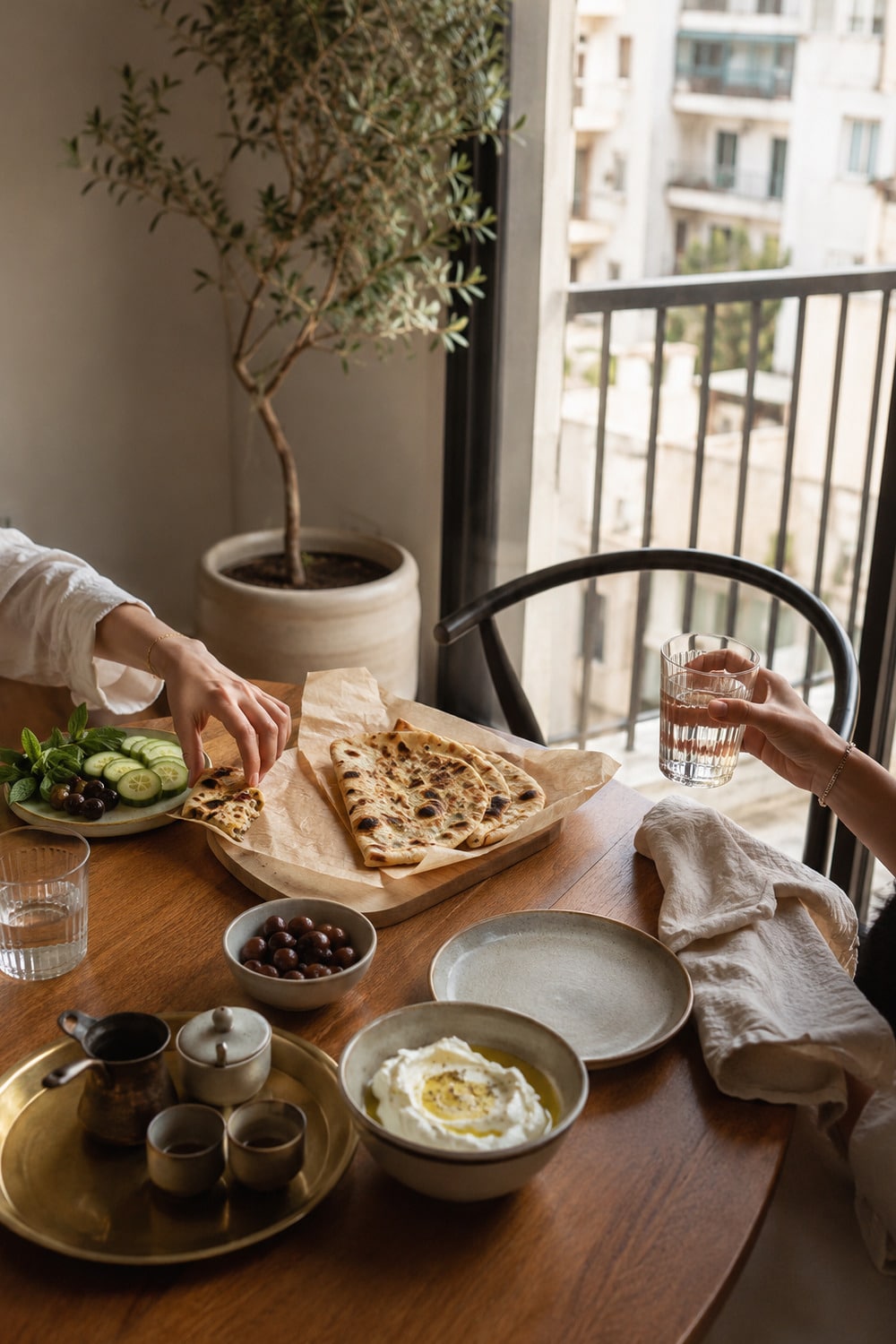
At home, the useful translation is to preserve the furn’s speed. Put the still-wrapped bread on a board, open the paper only when people sit down, and add one knife or pair of kitchen scissors for dividing it. A heavily decorated table would work against the bakery logic documented in Hamra and Gemmayzeh. A plain board, two or three small bowls and clear drinking glasses let the heat, aroma and changing shape of the bread remain the centre of the morning.
Small Dishes Make Room for Choice
Several inspected breakfast pages describe manakish beside labneh, olives, cucumber, herbs or cheese. Read narrowly, this is not proof of a fixed national breakfast. It is evidence that a spread can be assembled from components with different textures and levels of richness. On a Beirut-inspired table, that means shallow bowls placed within easy reach, with enough empty space for the folded bread to land without covering every dish.
Within this carefully scoped view of Lebanese women lifestyle, choice also controls waste and visual clutter. Begin with modest portions that can be replenished from the kitchen: a spoonful of labneh, a few olives, sliced cucumber, mint or another herb that is actually available. The table then grows in response to the people present. This incremental method suits a small Beirut apartment table better than an oversized display, and it keeps hospitality connected to attention rather than abundance for its own sake.
From Bakery Paper to the Home Table
In this Beirut breakfast feature, Lebanese women lifestyle is not represented by décor; the paper around a man’ouché is not an embarrassment to hide before a guest arrives. In this setting it records where the meal began and protects the bread while it travels from the furn. Fold the paper back instead of replacing it with a serving cloth, then place the parcel on a washable board or tray. The contrast between practical paper and a ceramic cup creates enough visual structure; extra props are unnecessary.
A table can still feel polished. In a Tabaris or Hamra apartment, one pressed linen runner, a low bowl of herbs and cups of similar scale would be sufficient. Keep flowers below eye level if they are used, because the meal is built around conversation across a compact surface. The beauty here comes from clear placement: bread near the centre, wet dishes on saucers, napkins where hands can reach them, and bags or phones moved away from the food.
This approach differs from the coffee-centred setting discussed in Ethiopian women lifestyle, where another article follows another place and another sequence. At the Beirut breakfast table, coffee is better held back for a later pause so the hot flatbread is not crowded by too many cups at once. Keeping those settings distinct makes the comparison useful without turning either ritual into a portable cultural label.
Urban Markets Extend the Table
American University of Beirut pages on the Food Heritage Foundation describe projects that connect small producers with urban residents. Souk Aal Souk was organised as a farmers’ market, while Food and Roots packaged products from rural producers for urban points of sale. These initiatives do not describe every Beirut shopping habit, but they show a contemporary route by which mouneh, produce and other foods can enter a city kitchen without pretending that the city produced them.
For this narrow treatment of Lebanese women lifestyle, the practical lesson is provenance without performance. A jar of preserved vegetables, a bottle of olive oil or a packet of herbs can stay in its ordinary container until needed. Decanting everything into matching vessels may erase useful information about the producer and turn food into decoration. In a Beirut-focused setting, the label, date and storage instructions are part of the table’s material life, especially when an item has travelled from another Lebanese region.
Season also sets a limit. The institutional market material names fresh produce, mouneh, pastries and saj, but it does not promise that every product appears at every moment. Build the table from what is genuinely available, then leave gaps. A winter breakfast might depend more on preserved items and warm bread; a hot-weather morning might use cucumber, herbs and chilled water. This is a design response to supply and temperature, not a claim about a universal Lebanese menu.
Coffee Creates a Second Pause
Within this specific Beirut setting, Lebanese women lifestyle is not treated as a personality type; coffee can arrive on a smaller tray once the bread and small dishes have been cleared or shifted. The change of scale matters in a Beirut apartment or café table: compact cups, a water glass and perhaps one plate for a sweet bite create a new phase without requiring a second meal. Serving coffee separately also gives the host time to wipe crumbs, open a window or move the gathering toward a balcony or sitting area if the space allows.
Conversation does not need to be choreographed into a trait called poise. At this table, poise is simply the management of pace: allowing a guest to finish, avoiding a rush to remove the cup, and keeping the tray light enough to move. The social confidence explored in Serbian women lifestyle belongs to its own setting; here, the useful observation is the Beirut table’s shift from a broad breakfast spread to a concentrated coffee moment.
Colour Comes from Food and Materials
The restrained palette used in this Lebanese women lifestyle feature already appears in Beirut bakery and market materials: browned dough, green herbs, pale labneh, dark coffee, clear glass and printed paper. A home table does not need a costume of flags, patterned tiles or prescribed “Mediterranean” colours to signal place. Warm stoneware, off-white linen and one metal tray can support the food while remaining compatible with many contemporary interiors in the city.
One controlled accent is enough. A muted red napkin, a small bunch of white flowers or a brass spoon can add contrast without claiming cultural symbolism. The modern composure discussed in Malaysian women lifestyle is shaped by another place; for this Beirut table, visual calm comes from repeating scale and material. Use cups of similar height, bowls that nest for storage and a tray that can move from kitchen to balcony.
What Can Travel Beyond Beirut
The most respectful adaptation of this Lebanese women lifestyle feature keeps the Beirut sequence and changes the ingredients. Outside Beirut, use a local bakery flatbread if man’ouché is unavailable, choose herbs suited to the season, and replace balcony service with a windowsill, dining bench or shaded outdoor table that fits the actual home. Do not rename the result Lebanese or present it as an authentic Beirut breakfast. The borrowed idea is a progression from portable bread to shared dishes and then coffee.
The serving pieces can travel more easily than the menu. A shallow bowl, a bread board, two compact cups and one tray reproduce the working scale of the Beirut sequence without pretending to reproduce a Beirut home. Store the bowls inside one another and use the tray for breakfast ingredients during the week. This keeps the adaptation useful in a small kitchen and prevents the cultural reference from becoming a display assembled only for guests.
Space and climate should guide the remaining details. In humid weather, use lighter linen and fewer uncovered dairy dishes; in a cold room, warm the board before the bread arrives and keep the coffee tray close. Readers may place this beside Czech women lifestyle reflections on another everyday setting, but the Beirut feature remains anchored to its furn, urban market links and compact table rhythm. That boundary preserves specificity while leaving the practical sequence open to adaptation.
Final Thought
Lebanese women lifestyle remains wider than this Beirut breakfast feature, which does not need to imitate a restaurant spread or turn hosting into spectacle. Its strongest shape begins with bread carried from a neighbourhood furn, expands through a few small dishes, and contracts again around coffee. That sequence answers the opening question: everyday poise can be built through timing, clear surfaces and responsive portions, while the city, the producers and the ingredients retain their own names and limits.
References and Further Reading
- The Definitive Guide to Breakfast in Beirut
- Flatbread Recipe: Manakish Zaatar
- Manousheh: the Lebanese breakfast pizza that stole my heart
- 15 Brilliant Places to Eat Lebanese Food in London
- FHF: Food Heritage Foundation
- “Manoushe Box” – Food and Roots
- What to eat in Lebanon, from flatbreads to layered desserts
- The Lebanese Bakery: A Taste Of Your Childhood In Lebanon
Related Reading