Editorial Note: This article explores cultural lifestyle inspiration in an editorial way. It does not claim to represent every woman, country, region, or personal experience. WorldsLadies avoids stereotypes and presents these ideas as gentle, adaptable lifestyle reflections.
In this Dar es Salaam setting, Tanzanian women lifestyle is easiest to approach at the level of streets, shops and working materials. Kariakoo places printed cloth beside ready-made garments and other everyday goods, while Manzese has long been documented as a centre for secondhand clothing. Newer curated retail has added another layer. Looking at these settings together gives a more precise route into Dar es Salaam textile culture than trying to turn a country into a single aesthetic.
The frame stays with contemporary Dar es Salaam, where Tanzanian women lifestyle is considered through a limited question: what can textile buying, design work and city retail reveal about how people make visual choices in daily life? The answer sits in concrete places such as Kariakoo, in a 2024 khanga exhibition held in the city, and in university and arts institutions that treat cloth, sewing and fashion as active creative fields.
That narrow frame matters because Tanzania contains many regions, languages, livelihoods and dress practices. Dar es Salaam does not stand in for the country, and the people quoted or described by any one source do not stand in for Tanzanian women. The useful observation is smaller: cloth moves through different urban systems, and those systems encourage us to notice function, message, scale and context before assigning cultural meaning.
Key Takeaway: Dar es Salaam offers a useful lifestyle lens when textile choices are read through specific markets, design institutions and contemporary retail instead of a national dress code.
Kariakoo Makes Cloth Part of the City
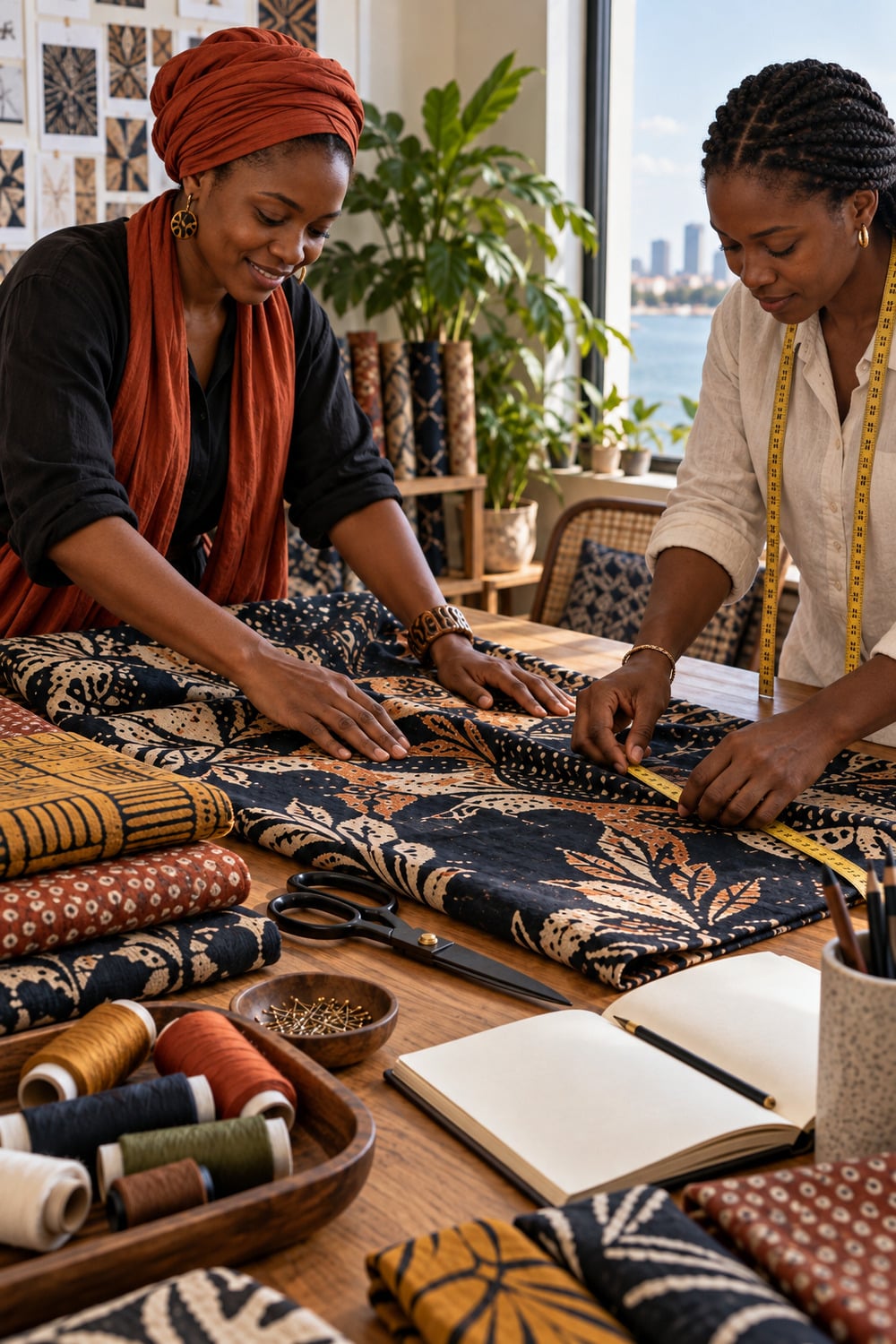
Kariakoo appears in reporting on Dar es Salaam as a dense commercial district where fabric, clothing and many other goods circulate at close range. A 2016 account described kanga and kitenge fabrics among the market’s visual layers and also noted clothing sold by auction. A 2015 city guide placed the same district within the city’s everyday movement and sound. The point is not spectacle; within this city context, Tanzanian women lifestyle stays grounded in a working retail environment where cloth is encountered as merchandise with price, quantity, handling and purpose.
That setting changes how a print can be read. Folded lengths have to attract attention among neighbouring colours, but a shopper still makes practical decisions about what the material will become and where it will be used. A border, a repeated motif or a strong contrast therefore belongs first to a physical object with scale and construction. Treating the fabric as an object before treating it as a cultural sign is a useful discipline when reading Dar es Salaam lifestyle.
Kariakoo also keeps the editorial lens honest about choice. The same district includes ready-made clothing and many unrelated categories of goods, so printed fabric is not the only route through city dress. An image that isolates one cloth and calls it the look of Dar es Salaam would erase the mixed retail environment documented there. A more accurate visual story lets several clothing systems occupy the same frame and leaves room for individual decisions.
Khanga Can Be Read Before It Is Interpreted
A 2024 exhibition and conference at Alliance Française in Dar es Salaam placed khanga at the centre of a public discussion. Reporting on the event described the cloth as a rectangular textile that commonly combines decorative design with printed Swahili wording. That feature gives a reader something concrete to notice: the cloth has a visual field and a textual field. Within this Dar es Salaam setting, Tanzanian women lifestyle stays with those visible fields rather than turning either into a universal statement about the wearer.
The same report traced changes in khanga design and wording while also acknowledging uncertainty around parts of the cloth’s origin story. That uncertainty is useful. It encourages a present-day reading based on what is visible and documented, without requiring a neat historical legend. In a Dar es Salaam shop or exhibition, a phrase can be translated and a border can be described, but the reason one person selected that cloth may remain personal, situational or simply unknown.
For a separate look at colour in a different setting, Senegalese women lifestyle can sit beside this Dar es Salaam discussion without turning either place into a template. Here, the practical method is to identify the cloth, read verified wording when it matters, and stop before inventing symbolism. That restraint keeps the material interesting on its own terms and makes comparison less likely to flatten distinct local histories.
Design Education Keeps the Material Contemporary
At the University of Dar es Salaam, a 2024 Art and Design project asked students to develop khanga and kitenge designs after practical training that included textile mills in Arusha and Morogoro. The university reported seventy five student designs and described a process that moved from research and motifs to industrial production methods. This is a specific educational project, not evidence for how every household dresses; within this Dar es Salaam design setting, Tanzanian women lifestyle stays tied to current design training rather than general household practice.
Dar es Salaam’s National Arts Council, BASATA, gives another institutional view of the present. Its 2025 craft-arts guidance includes clothing, fashion design, embroidery, weaving and sewing among recognised fields, alongside training, exhibitions and market support. Read together, the university and council material shifts the story away from frozen heritage. Cloth in the city can be studied, designed, sewn, exhibited and sold through contemporary systems with their own professional requirements.
Dar Retail Moves Between Market and Curated Store
The city’s clothing landscape is not one retail tier, which keeps Tanzanian women lifestyle tied to Dar es Salaam clothing retail rather than a single shopping image. A 2016 report described Manzese through its secondhand clothing trade and Kariakoo through fabric stalls and clothing auctions. Four years later, reporting on the Dar es Salaam founder of the fashion platform Industrie Africa pointed to The Green Room, a city concept store that had worked with local designers and makers. Those sources capture different moments, but together they show why a single polished boutique or market photograph cannot describe the whole city.
This range is useful when thinking about access and styling without turning either into a social ranking. Secondhand garments, fabric bought for making, ready-made pieces and curated designer items involve different budgets and decisions. The sources do not establish who uses each route or how often, so the safer observation is structural: Dar es Salaam contains multiple channels through which clothes reach a wardrobe. Any lifestyle feature should preserve that plurality instead of assigning one channel to one kind of woman.
For a reader, the most transferable idea is a shopping sequence, not a look. Start with the function of the garment, then notice material, cut and colour, and only then consider whether a printed element earns the visual emphasis. That sequence reflects the practical variety visible across Dar es Salaam retail without copying a named textile or treating local design as decoration. It can work with clothes already owned, which keeps inspiration separate from cultural acquisition.
It also helps distinguish a city’s creative economy from a national identity claim. Industrie Africa was founded in Dar es Salaam, but the platform was built to cover designers across the African continent; The Green Room was one local retail reference within that wider story. Its existence says something about a contemporary design network in the city at that moment. It does not prove that curated designer shopping is the norm in Dar es Salaam or anywhere else in Tanzania.
Personal Styling Can Keep the Source Visible
When a Dar es Salaam textile sparks a styling idea, the Tanzanian women lifestyle frame remains specific to that city setting and the borrowed element stays limited. A reader might work with one print-to-solid colour relationship, the scale of a border, or the way a strong fabric is balanced by a simple garment shape. Those are observable design decisions. Copying a complete ceremonial or identity-coded look without understanding its setting would ask the material to do work the sources cannot support.
The same principle applies to beauty choices around a vivid garment. Someone inspired by a Kariakoo fabric display might choose the soft makeup look as a personal styling counterpoint, but that pairing belongs to the reader, not to Dar es Salaam. Keeping that distinction explicit prevents an optional beauty choice from being presented as local grooming practice, while the textile remains connected to the city context that prompted the idea.
Tanzanian Women Lifestyle Through a Dar es Salaam City Lens
The sources used here are deliberately uneven in scale: a market district, a university project, an arts council page, an exhibition, a concept store and a few pieces of reporting produced between 2015 and 2025. None can establish a single Tanzanian women lifestyle, and none should. What they can do is keep that phrase within a Dar es Salaam city context by showing where cloth is traded, how it is discussed publicly, and how design enters institutional and retail settings.
Readers who enjoy grounded regional lifestyle writing may also visit Rwandan women lifestyle, while keeping the places and practices in each story separate. The useful habit is not to collect national traits. It is to ask what exact setting produced an observation, who or what the source actually describes, and which parts remain unknown. That habit matters especially when a capital city is visually prominent but geographically limited.
Within Tanzania, another city, a rural district, a coastal island or a different workplace could produce a very different clothing story. Even within Dar es Salaam, Kariakoo, Manzese, a university studio and a curated shop do not offer the same choices. Treating variation as part of the subject makes the city more legible, not less. It also gives a reader a practical boundary: borrow a design method or observation, while leaving unverified cultural meaning where it belongs.
Final Thought
Dar es Salaam becomes most useful as a lifestyle reference when the frame stays close to actual places and materials. Kariakoo shows cloth in a working retail system; a khanga exhibition makes text and design available for careful reading; university and arts institutions show contemporary making; and other shops widen the retail picture. Seen this way, Tanzanian women lifestyle stays within the Dar es Salaam city context: it is not a set of traits to copy but a disciplined way of noticing how city context changes what an object can mean and do.
References and Further Reading
- Art and Design students leverage cultural artifacts to take Khanga and Kitenge tapestry to next level
- SANAA ZA UFUNDI-BASATA
- Get to know kanga as a powerful communication tool
- An insider’s cultural guide to Dar Es Salaam: laid-back bustle and bongo flava
- Megacity in waiting: Dar es Salaam is basking in its post-millennial revival
- This New Shopping Site Makes It Easy to Discover African Fashion Brands
Related Reading