Editorial Note: This article explores cultural lifestyle inspiration in an editorial way. It does not claim to represent every woman, country, region, or personal experience. WorldsLadies avoids stereotypes and presents these ideas as gentle, adaptable lifestyle reflections.
In Karachi, cloth can be encountered as a museum object, a design-school reference, a retail material and a contemporary fashion surface. That makes the city a useful setting for a careful Pakistani women lifestyle feature: not a claim about how women across Pakistan live, but a close look at how color and textile detail move through specific public design spaces in the mid-2020s. The city examples are deliberately ordinary in scale—a museum gallery, a campus resource room, a mall exhibition and a home-textile shop—so the focus remains on material decisions that can actually be observed.
The clearest starting point is KDA Scheme No. 1, where The Haveli opened its inaugural textile exhibition in December 2024, and Clifton, where the Indus Valley School of Art and Architecture keeps printed, woven, embroidered and experimental fabric samples in its textile resource centre. These are documented places with different functions—one a museum collection, the other a teaching resource—and neither stands in for an ordinary Pakistani home.
The practical question is therefore narrow: in this Karachi setting, Pakistani women lifestyle asks how a reader can notice color, texture and craft, then make a restrained choice for clothing or a home table without copying a regional identity. The answer depends on keeping technique, object and setting separate, and on treating historical pieces differently from contemporary design.
Key Takeaway: Karachi’s museums, design resources and current craft displays suggest a material-first approach: notice how cloth is made and used before borrowing color or texture for your own setting.
Pakistani Women Lifestyle Through Karachi Textile Context
The Haveli’s inaugural exhibition, A Coat of Many Colours: Textiles from Sindh, displayed 65 objects and explicitly framed its subject as the textile traditions of Sindh. The wider collection contains more than 1,000 objects, while the first exhibition ran from December 2024 into November 2025. That geographic and temporal label matters here: Pakistani women lifestyle remains a Karachi-focused frame, while Sindh textile craft stays attached to the exhibition’s own regional label. A piece collected in Sindh can carry information about a particular community, technique or period, but its presence in a Karachi museum does not turn it into a visual shorthand for the whole country. The museum setting encourages close looking at an object before any lifestyle adaptation begins, and the exhibition dates help prevent a current gallery display from being confused with an unchanged daily practice.
A short drive away in Clifton, the Agha Hasan Abedi Textile Resource Centre at IVS gives a different kind of context. Its holdings include printed, woven, embroidered and experimental samples, with textiles gathered from Pakistan’s provinces alongside student thesis work. The same campus lists a sewing room and printmaking studio, placing reference material close to active making. The useful distinction is between archive and experiment: a historical or regional sample can be studied as evidence of material practice, while a student project shows that textile design is also an active contemporary discipline in Karachi. This is a stronger basis for lifestyle reflection than treating a museum piece as a ready-made decorating rule.
For a reader, the Pakistani women lifestyle context is deliberately narrow: identify the object, the technique and the documented place before deciding what attracts you. You may be responding to a contrast of matte cotton and reflective detail, to dense stitching, or to a particular scale of pattern. If color is your main entry point, Nigerian women lifestyle offers a different setting for thinking about palette and community; the Karachi material here stays tied to named collections and current design spaces.
Color Works Better as Material Than Symbol
Color becomes easier to handle responsibly when it is described through fabric and process. The V&A’s embroidery collection, for example, identifies phulkari with the wider Panjab region and illustrates a nineteenth-century piece from Bannu in present-day Pakistan; it also documents a mid-twentieth-century tunic from Sindh with mirror-glass embroidery. Those object records show why “Pakistani color” is too broad a label. Region, date, base cloth, thread and surface technique change what the viewer is actually seeing.
For an everyday wardrobe or room, the safer adaptation is relational rather than symbolic. Start with the material relationship that caught your eye: a dark ground against brighter thread, a quiet cotton beside a reflective accent, or a patterned textile against a plain wall. Keep the borrowed element small enough that it still reads as your own styling decision. Here, Pakistani women lifestyle stays focused on a Karachi reading, where textile color in Karachi is not a cue to assign meaning to teal, red, gold or mirror work; the point is to notice how material contrast changes visual weight.
A Home Detail Can Stay Separate From Cultural Identity
Karachi’s 2025 Sartyoon Sang crafts exhibition at Ocean Mall is useful because the display placed textile techniques across several product types. Dawn reported rallis, embroidered clothing, ajrak, bags, wall pieces, baskets, boxes, planters and other objects in the same retail setting. That range does not prove what appears in Karachi homes, but it does show that craft can circulate as clothing, furnishing and small object at a contemporary city exhibition.
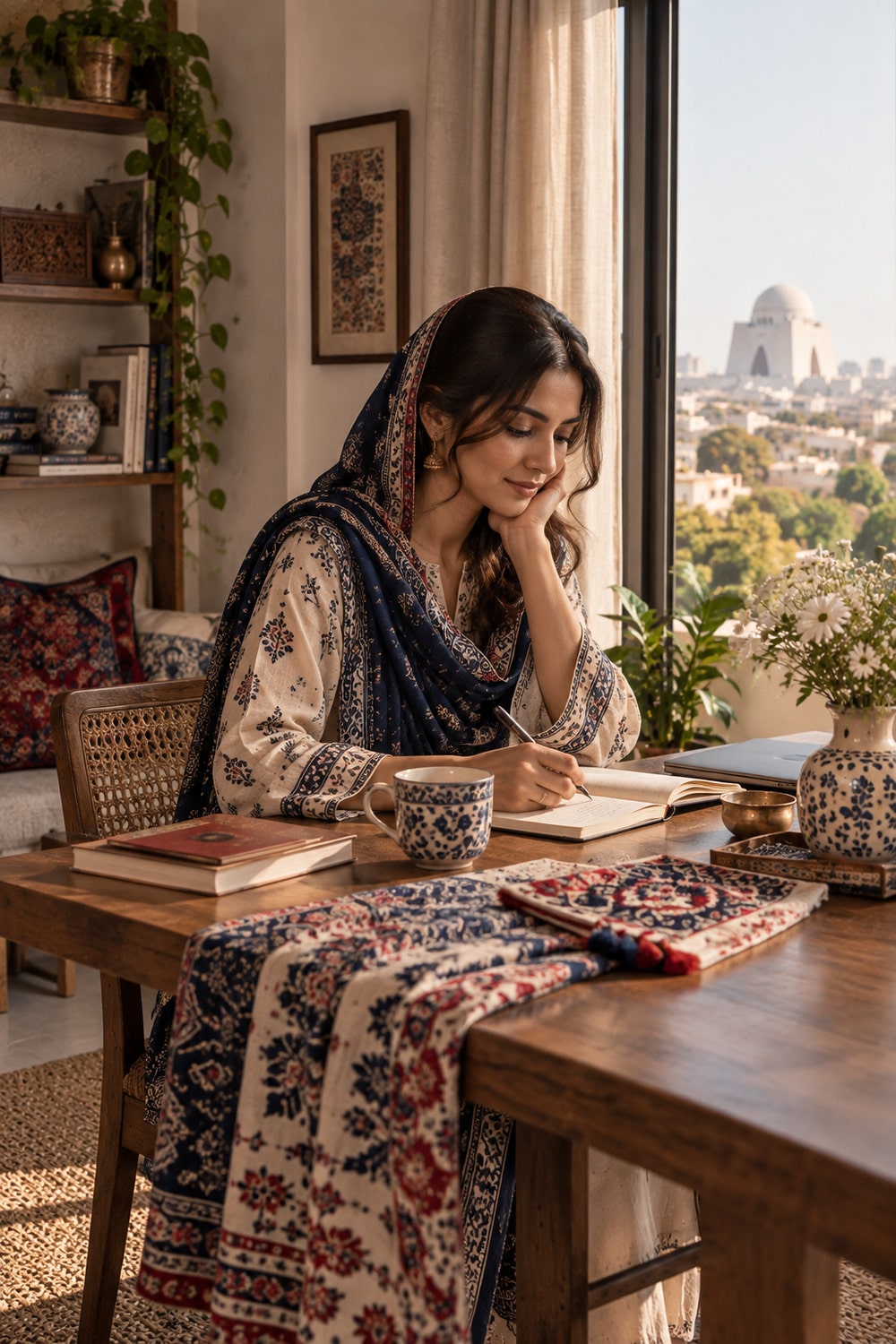
If your own routine includes a family meal, tea with friends or a quiet desk break, you can use that retail observation without calling the result culturally representative. Place one patterned textile beside plain ceramics, or let a stitched cushion sit against an otherwise restrained sofa. The decision is about proportion: one detailed surface has room to be seen when surrounding objects are calmer. A Karachi source supplies the material context for this Pakistani women lifestyle feature; your household supplies the ritual.
A separate 2025 home-textile opening on Tipu Sultan Road makes the contemporary interior connection more concrete. The shop display described sheets, drapery, towels, mats and other fabric-led home goods, all presented for shoppers to compare by finish and feel. Its commercial language should not be mistaken for a citywide preference, but the store is evidence that textile decisions in Karachi also sit inside current retail life, alongside museum conservation and craft exhibitions. For adaptation, function comes first: bedding, a table layer and a wall textile ask for different durability, scale and cleaning habits.
Contemporary Design Keeps Technique in Motion
Lahore offers a useful comparison without being asked to represent Pakistan. The streetwear label Rastah has used hand block printing and handwoven fabric in hoodies, jackets and other contemporary forms. Its work demonstrates a design choice that matters here: a technique associated with older craft practice does not have to be frozen into a museum silhouette. The designer’s own collections are one maker’s interpretation, not a national dress code.
Karachi’s design education adds another layer to this Pakistani women lifestyle context: at IVS, Karachi textile design is encountered through traditional and contemporary samples in a resource centre, while its studios support printmaking, sewing and other forms of making. That adjacency helps separate craft appreciation from imitation. A reader can study the logic of a technique—repeat, stitch density, woven structure, surface reflection—then choose a modern object that suits present-day use. A dense embroidered surface may work better as a single cushion or framed textile than as a repeated room-wide pattern; a printed cotton can serve a lighter, more washable function. The result can acknowledge where the visual idea came from without claiming the original context.
This distinction also helps with heirlooms and repair. A family textile has a personal history that a newly purchased patterned object does not automatically acquire. For a different craft setting, Slovak women lifestyle considers making and family memory through another place. In Karachi, the stronger lesson from museums and design schools is to preserve the difference between documented heritage, contemporary designer work and private household meaning.
Occasion Changes the Amount of Detail
The inspected collections also make it difficult to defend one fixed “Pakistani beauty” look. Textile records move between everyday garments, historical pieces, wedding-related objects, streetwear and gallery displays, each with different levels of ornament. A useful styling choice is therefore occasion-based. Dense embroidery or reflective surface work can carry visual weight on its own, while a workday outfit or small room may need only one concentrated detail.
That boundary is especially important for personal beauty. Here, Pakistani women lifestyle stays within the feature’s Karachi textile subject: the institutions can support a discussion of cloth, pattern and surface; they do not establish a rule for eyeliner, fragrance, hair or jewelry across Pakistani women. Keeping the claim at the level of fabric makes the feature more precise. If a richly worked textile is the focus, let grooming and accessories answer the actual event, climate and personal preference instead of a presumed national aesthetic.
Karachi Is a Lens Not a National Template
The documented network is specific: a textile museum in KDA Scheme No. 1, an art and design school in Clifton, a craft exhibition in a Karachi shopping mall, and a contemporary home-textile store on Tipu Sultan Road. Together they show that cloth in Karachi can appear as collected heritage, research material, student reference, retail craft and household merchandise. They do not show how every resident decorates, dresses or hosts. They also cover different price systems and purposes—from museum access and student research to artisan sales and branded retail—so combining them into one presumed lifestyle would erase the very differences that make the city evidence useful.
Regional labels also need to stay attached to the objects that carry them. The V&A distinguishes Panjab phulkari from a Sindh mirror-work garment; The Haveli’s first exhibition was explicitly about textiles from Sindh; Dawn’s craft report identified artisans and work connected with places including Khairpur and Larkana. Those distinctions are more informative than folding every stitch into one national palette. They also leave room for urban and rural settings, makers, price points and periods to differ.
A practical adaptation can use four questions before anything is bought or styled: What technique am I looking at? Where and when is this example documented? Am I borrowing a material relationship or copying a culturally specific object? Will the new use make sense in my climate, room or event? This keeps Pakistani women lifestyle within a specific Karachi research frame while giving the reader a usable decision process instead of a catalogue of “traditional” looks.
Final Thought
Karachi offers a precise way to read color and craft: begin with the textile as an object, locate its region and period, notice the technique, then decide whether a small material relationship fits your own wardrobe or home. That sequence preserves the value of the museum, school and craft settings without asking any one object—or any one woman—to represent Pakistan.
References and Further Reading
- Nasreen Ki Haveli – The Haveli, Karachi supported by The Hasan A. Foundation
- Facilities at IVS – IVS
- Indian embroidery
- How Rastah Champions Pakistani Culture Through Streetwear
- Sindh craftspersons’ delicate needlework on display in Karachi
- A fresh take on everyday comfort
Related Reading