Editorial Note: This article explores cultural lifestyle inspiration in an editorial way. It does not claim to represent every woman, country, region, or personal experience. WorldsLadies avoids stereotypes and presents these ideas as gentle, adaptable lifestyle reflections.
Kigali offers a useful setting where lifestyle renewal stays focused on what can actually be documented: streets temporarily reassigned to pedestrians, a planned mixed-use district in Kinyinya, and contemporary buildings in Kacyiru where brick screens respond to heat, light and airflow. Those examples describe particular urban decisions in Rwanda’s capital. They do not describe a single way of living across the country, and they do not stand in for the experiences of women as a group.
That narrower frame changes the question behind a Kigali cultural lifestyle feature. Instead of turning a place into a collection of personality traits, it asks how public space, material function and provenance can guide an everyday reset. A room can be reorganised around movement, a purchase can be checked for maker and origin, and a visual reference can stay connected to the setting that gives it meaning.
The time frame also keeps lifestyle renewal tied to dated evidence. The public-space example below comes from a City of Kigali account of its 2019 Car Free Day programme; Kinyinya’s master plan was released in 2024; the Kacyiru brick project is documented in 2026. Imigongo enters the feature through a separate 2024 safeguarding workshop in Kirehe and Ngoma districts, rather than being presented as generic Kigali décor.
Key Takeaway: In contemporary Kigali, everyday renewal is most responsibly read through public-space use, material function, and clearly located craft context.
Lifestyle Renewal Through Kigali Public Space
An account prepared around the 2019 Wellbeing City Award describes Car Free Day on selected roads on the first and third Sundays of the month, with walking, running and cycling scheduled from 7 a.m. to 10 a.m. The useful detail is spatial: this Kigali public space, normally organised around vehicles, temporarily takes on another function. Because the source belongs to a 2019 award cycle, it is best treated as a dated example of how the city administration described the programme at that time, not as a promise about the current 2026 timetable.
At home, lifestyle renewal works best when the transferable idea is not to reproduce a city event indoors. It is to change the job of a small area for a defined period. A Kigali street in the documented programme shifted from traffic to movement; at home, an entry surface can shift from a drop zone to a clear landing place, or a table can be cleared for an evening task. The connection is functional and temporary, which keeps the adaptation grounded instead of turning “renewal” into a vague cultural quality.
That distinction also makes community easier to discuss without assigning responsibility to a gender. In the Kigali example, access depends on a scheduled public-space condition created by the city, not on an assumption that particular residents naturally provide care. A different WorldsLadies feature, Nigerian women lifestyle, remains its own cultural context; here, the relevant Kigali observation is simply that shared space can be designed or timed to support a different kind of use.
Kinyinya Puts Daily Life Into the Plan
The Green City Kigali Concept Master Plan released in September 2024 is deliberately specific: it covers Kinyinya Hill in Gasabo District, including six named villages, and follows public consultation held in November and December 2023. The plan describes a mixed-use first stage with housing, shops, public spaces and public transport, while road alignments and non-motorised routes are intended to improve connection across the area. These are planning commitments for a defined project, not evidence that every Kigali neighbourhood already works this way.
For a reader thinking about lifestyle renewal at home, Kinyinya suggests a practical “functional adjacency” check. The master plan places different daily needs in relation to one another; a smaller domestic version can ask whether the objects used together are actually stored together. Shoes and a bag may belong near the exit, while a charging cable may belong where a device is usually set down. The point is not to imitate the plan’s appearance. It is to notice that distance, sequence and access can make an ordinary routine easier to repeat.
Kinyinya also provides a useful limit: a planning document can show intended relationships between routes, services and public space, but it cannot tell us how every resident will experience them. That same boundary matters when moving between WorldsLadies articles. Senegalese women lifestyle and Ethiopian women lifestyle need evidence from their own settings; neither can be used to fill a gap in Kigali. Place-specific lifestyle writing becomes stronger when comparison stops before it turns separate cities or countries into a single aesthetic category.
Kacyiru Brick Shows Why Function Comes Before Look
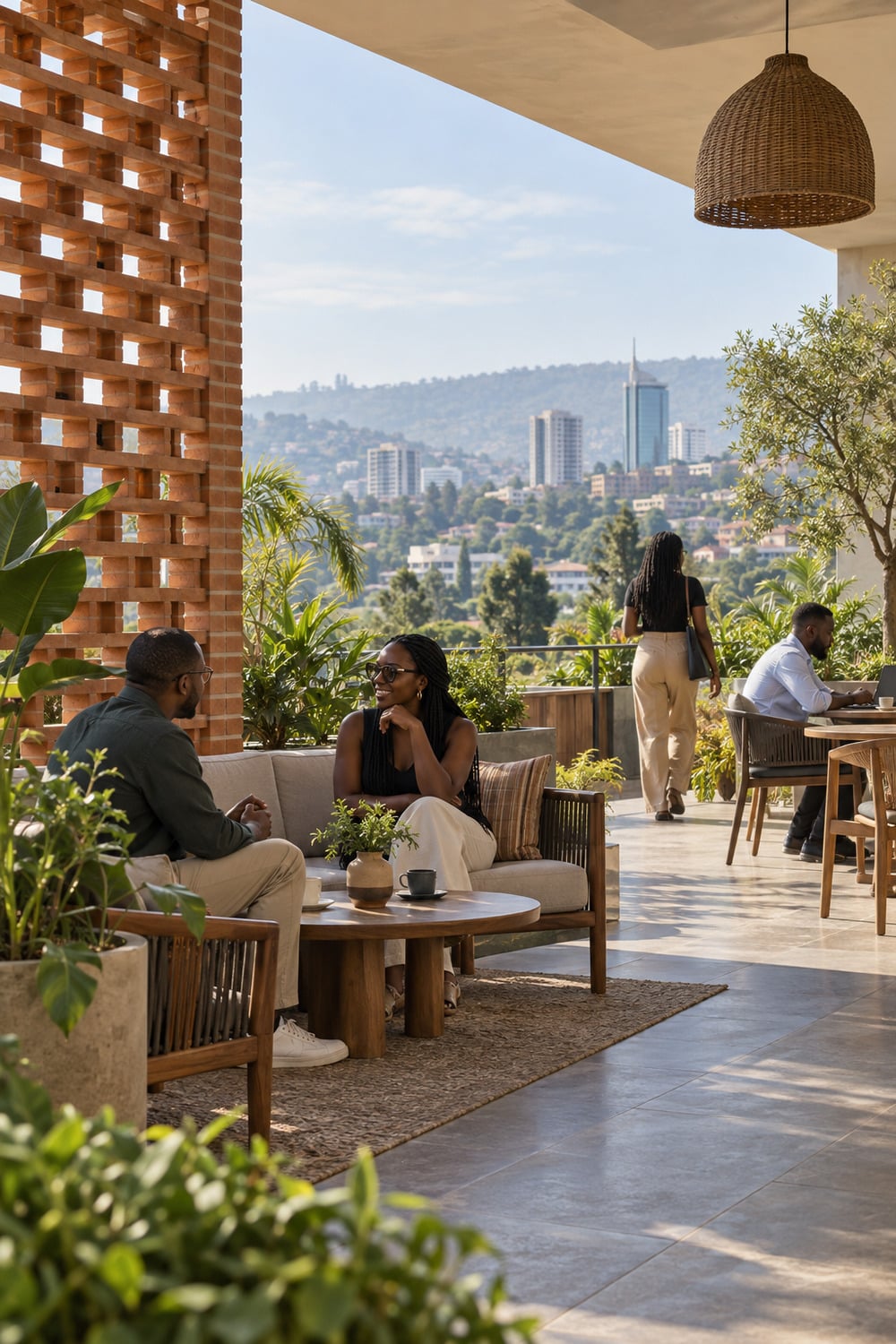
A 2026 mixed-use building in Kigali’s Kacyiru district offers a more material example. The Brick Tower uses a reinforced-concrete structure clad with fired clay bricks made by a local women’s cooperative. Its perforated west façade concentrates circulation and services where the building needs protection from heat gain, while the remaining floor plan benefits from natural light and cross-ventilation. The important editorial point is not that brick is a national style. In this one project, a material and a façade pattern are doing identifiable environmental work.
That gives lifestyle renewal a “material before motif” test. Before copying a perforated pattern because it looks connected to Kigali, ask what problem the original detail solves. If the need is glare, a screen or adjustable blind may be more relevant than decorative brick; if the need is airflow, an unobstructed opening may matter more than colour. The test keeps a design idea attached to function. It also prevents one photographed building in Kacyiru from becoming a shorthand for how homes across Kigali or Rwanda are supposed to look.
Imigongo Needs Its Own Geography
Imigongo belongs in this feature only with its location made explicit. A March 2024 safeguarding workshop took place in Kirehe and Ngoma districts, east of Kigali, and brought together community members, producers, researchers, educators and officials. The accompanying material describes geometric decorative work made with earth, cow dung and grass, often using black, white and red. That evidence supports discussion of materials and workshop context. It does not make every geometric object in Rwanda an example of Imigongo.
A provenance check keeps lifestyle renewal more precise than treating the craft as a decorating shortcut. When an object is sold or described as Imigongo, ask where it was made, who identifies it that way, and whether the seller or institution provides a credible maker or production context. If those answers are unavailable, a generic geometric print should remain a generic geometric print. That small discipline protects the distinction between an identifiable practice and a pattern chosen only because it fits an editorial mood.
The same care changes how such an object sits in a room. An item with clear provenance does not need a staged “heritage corner” or an invented story to justify its presence. It can be used or displayed in an ordinary contemporary interior while its maker and place remain legible. For readers outside Rwanda, that may mean buying from a source that can explain production, or simply appreciating documented examples without acquiring a lookalike. Restraint is more accurate than turning a regional practice into a portable theme.
Colour deserves the same boundary. The safeguarding material notes black, white and red among colours often used in the documented art, but the feature should not convert those colours into a universal code for Rwanda or attach unsupported meanings to them. In a contemporary room, a black-and-white relationship can be appreciated as a visual choice without claiming that the combination carries a fixed national message. The geographic label, material record and maker context do more useful work than invented symbolism.
Contemporary Kigali Is Made of Specific Projects
Contemporary Kigali gives lifestyle renewal a more precise reference when read through individual businesses and commissioned spaces rather than a citywide aesthetic. In Kimihurura, Laini ceramics studio opened in 2019. Zaria Court became operational in June 2025 as a mixed-use site with sport, hospitality, work and public-facing spaces. Those examples exist at different scales and moments. Neither provides a census of Kigali taste, income, access or everyday routine.
That leads to a useful project-versus-population rule. When a photograph, shop or building is compelling, name what it actually is before extending the observation. A ceramics studio can support a sentence about that studio; Zaria Court can support a sentence about its programme and design. Neither supports “Kigali residents prefer” or “Rwandans live” claims. The rule may sound restrictive, but it creates room for richer detail because the writing can describe a brick screen, courtyard use or retail setting without turning the detail into a national personality.
Kigali’s own examples already show why one label is too coarse. Kinyinya is a planning process, Kacyiru supplies a building case, Kimihurura appears through individual studios, and Zaria Court is a commissioned hub with its own programme. Keeping those scales separate produces a clearer city picture than blending them into one “Kigali look.” It also leaves room for other neighbourhoods, budgets and forms of daily life that these selected sources do not document.
A Kigali Reset Can Stay Small and Concrete
Placed together, the Kigali and eastern Rwanda examples connect lifestyle renewal to a simple place–function–provenance method. Start with place: is the idea tied to a Kinyinya plan, a Kacyiru building, a documented street programme, or a Kirehe and Ngoma craft setting? Then check function: does the feature concern movement, shade, storage, public access or the use of a material? Finally check provenance when a cultural object is involved. This sequence keeps an adaptation specific enough to learn from without claiming ownership of a wider culture.
At home, the method can produce a modest reset: clear a route through the room because movement is the actual problem, use a screen where afternoon glare is the issue, or keep a well-documented handmade object visible without surrounding it with borrowed symbolism. If the evening transition is the practical concern, cozy evening rituals can sit alongside that home-focused task without being used as evidence about Kigali. The useful outcome is a routine linked to a real function, not a performance of place.
Final Thought
A careful Kigali cultural lifestyle feature keeps lifestyle renewal close to documented scale. A dated street programme shows how public space can change function; Kinyinya shows intended connections between routes and daily services; Kacyiru shows brick working as shade and ventilation; Imigongo keeps its Kirehe and Ngoma context. Those examples do not add up to one Rwandan way of life. Together, they offer a precise method for noticing place, function and provenance before adapting an idea elsewhere.
References and Further Reading
- Press Release: City of Kigali Launches Green City Kigali Master Plan for Kinyinya Hill
- City of Kigali shortlisted for global award
- Brick Tower mixed-use building in Kigali
- Capacity building for the safeguarding of Rwanda’s Imigongo Decorative Art
- In Kigali, Rwanda, a New Wave of Creative Projects Worth Traveling For
- NLÉ transforms historic site into dynamic community hub Zaria Court – the first of its kind in Rwanda
Related Reading