Editorial Note: This lifestyle article is for general editorial inspiration only. It is not financial, medical, legal, travel, safety, or professional advice. Adapt every idea to your personal needs, budget, culture, location, and circumstances.
Late summer puts jeans in an awkward middle ground. The fabric can feel right for a cool morning, yet a dark outfit, heavy shoe, and thick jacket may become uncomfortable by midafternoon. Useful transitional denim outfits begin with the warmest part of the day, then add only what the cooler hours genuinely require.
Late summer denim styling is not about dressing as though autumn has already arrived. It keeps the ease of a summer outfit while giving denim enough structure for work, travel, dinner, or a breezy evening. Wash, hem length, footwear, and the way a layer is carried matter more than buying a new seasonal wardrobe.
Key Takeaway: Build transitional denim outfits for the day’s warmest hours, then use one removable layer and seasonally light footwear to handle the cooler edges.
Transitional Denim Outfits Start with the Warmest Hours
The base of transitional denim outfits should suit the period when you are most likely to feel warm. A sleeveless cotton top, linen shirt, fine knit tee, or loose poplin blouse gives jeans a lighter starting point than a sweater worn all day. Coverage can be added later; trapped warmth is harder to correct when you are commuting, walking between appointments, or sitting on a sunny terrace.
Then check where the day takes you, not just the clock. An air-conditioned office, shaded train platform, coastal breeze, or outdoor dinner may call for a layer even when the afternoon forecast looks mild. A jacket that folds over a bag, a cardigan that can sit on the shoulders, or an open shirt gives you an answer without becoming the visual centre of the outfit.
This also clarifies what transitional denim means in practice: the jeans remain constant while the upper half changes with the setting. The outfit is successful when it still looks complete after the layer comes off, because that is the version you may wear for most of the day.
Denim Wash Changes the Seasonal Read
One practical way to style jeans in late summer is to keep the wash visually light. Mid-blue and faded blue denim work especially well beside white, pale blue, ecru, or soft tan. Cream and white jeans can stay in rotation with deeper accessories, while dark indigo works best when the top or shoe leaves some air around the look. The question is not which wash is universally best, but whether the surrounding colours make it feel August-ready or fully autumnal.
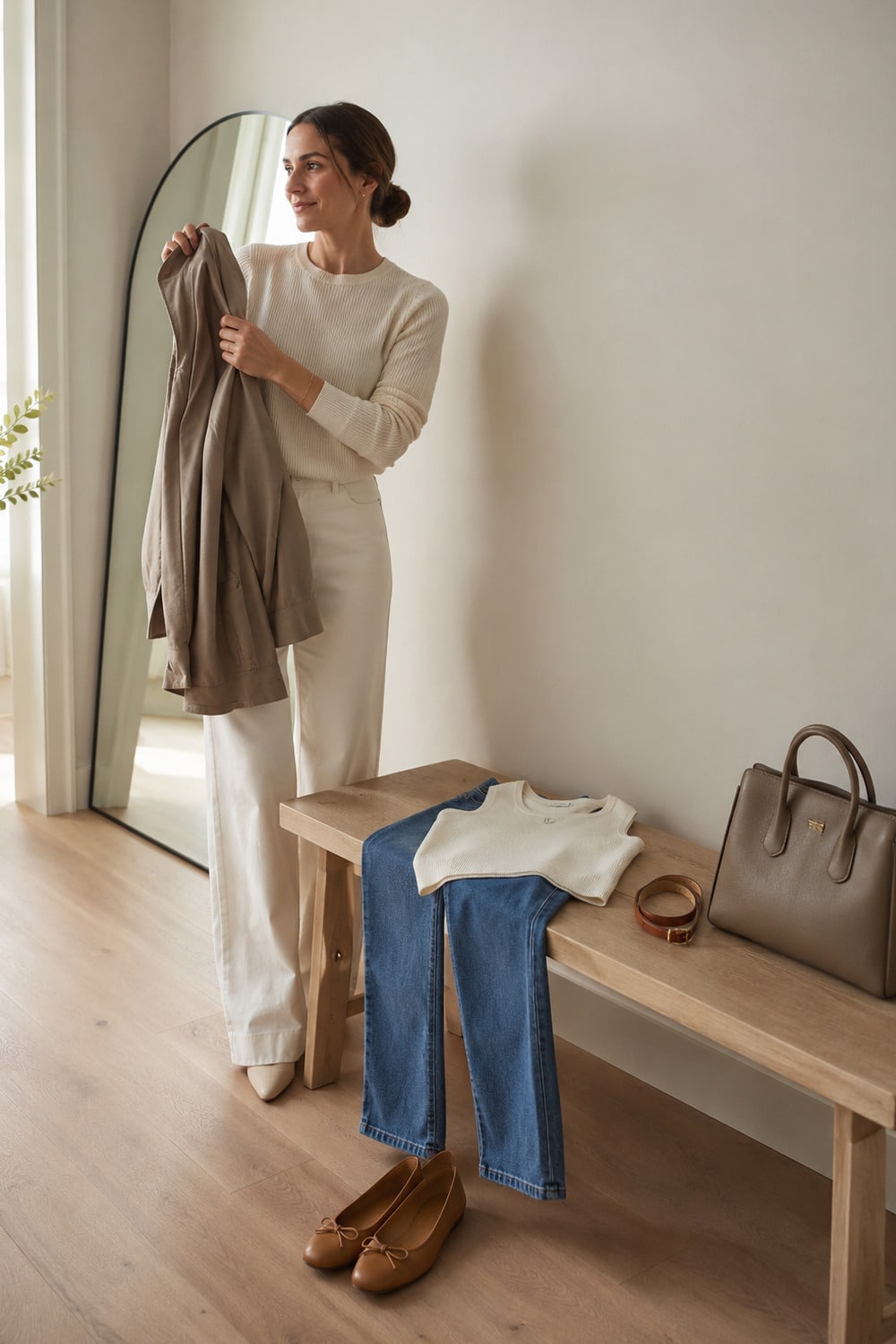
Use deeper colour in a small, repeatable area before shifting transitional denim outfits toward autumn. A narrow belt, sandal, bag, or light jacket in brown can introduce the next season without making the base feel heavy. The rich neutral in espresso brown style is especially useful here because it can appear once near the face and once near the hem, giving blue or cream denim a deliberate frame.
Build Proportion from the Hem Upward
The hem is the hinge between the jeans and the rest of the outfit. Cropped straight jeans leave room for a flat, slingback, or slim loafer and usually pair well with a shirt that ends at the hip. Full-length wide-leg jeans already carry visual volume, so a closer top or a clearly defined waist prevents the outfit from becoming one continuous block of fabric.
Relaxed and barrel shapes need a different check: look at where the leg narrows and whether the shoe remains visible. A substantial upper layer can work, but its length should not compete with the widest part of the jeans. A short jacket, tucked tee, or open shirt with a visible waistband often gives the eye a clean break.
When jeans look untidy, accumulated volume is often the issue. A long shirt, long jacket, wide leg, large bag, and heavy shoe all ask for attention in the same outfit. Remove one source of volume before replacing the jeans; the simplest correction may be a smaller bag or a layer worn open.
For a quick mirror test, check three points: the waist or upper-hip line, the amount of shoe visible, and the place where the jacket ends. Those points should not all land at the widest part of the body or garment. This is a practical way to make familiar jeans look considered without relying on a specific trend cut.
The Evening Layer Needs an Exit Plan
A late-summer layer should solve a real temperature change and remain manageable when it is not being worn. Unlined blazers, cotton chore jackets, fine cardigans, lightweight trenches, and overshirts can all complete transitional denim outfits, but their usefulness depends on the rest of the day. A jacket that creases badly in your hand or fills an entire tote may be too demanding for a brief evening chill.
Match the layer to the jeans before matching it to the season. A cropped jacket gives shape to wide or barrel legs; a longer unstructured blazer can settle a straight or slim pair; an open overshirt suits relaxed denim when the base underneath is simple. The proportions explored in light jacket outfits become more useful when the jacket can come off without exposing an unfinished combination.
There is also a practical limit to layering. If the day stays hot and the cooler setting lasts only a few minutes, a fine scarf or sleeves that roll down may be enough. Transitional dressing should reduce friction, not leave you carrying several pieces for an outfit that only works in one brief window.
Footwear Keeps the Outfit in Late Summer
Shoes determine how quickly denim moves toward autumn. Open or low-profile styles such as sandals, ballet flats, slingbacks, clean sneakers or trainers, and slim loafers keep some visual lightness around the hem. Boots can work on a cooler day, but pairing them with dark denim and a heavy jacket may shift the entire outfit beyond the season you are actually experiencing.
Choose for the route as well as the photograph. A delicate flat may suit dinner but not a long walk; a canvas trainer may be comfortable but too casual for a tailored workplace. When the day includes both, keep transitional denim outfits polished through the jeans and top, then use a neat walking shoe whose shape does not overwhelm the hem. Breathability, rain, and pavement all deserve more weight than a seasonal label.
Repeated Colours Make a Small Wardrobe Coherent
A limited palette helps the same jeans work across several late-summer weeks. Repeat one colour above and below the denim: tan sandals with a tan belt, an ivory top with an ivory bag, or a brown jacket with a brown hair accessory. The repetition does not need to be exact; it only needs to be close enough that the outfit has a visible connection.
This is particularly useful when you are trying to buy less. Instead of assembling separate summer and autumn looks, keep the jeans and warm-weather base, then change one of three things: coverage, texture, or colour depth. A linen shirt gains coverage from a cardigan, a smooth tank gains texture from a woven belt, and pale denim gains depth from brown accessories. Changing every element at once usually creates a heavier outfit than the weather requires.
The same editing principle supports a summer to fall capsule wardrobe, but denim makes the decision easier because the base stays familiar. Test each addition against at least two pairs of jeans and one warm-weather top. If it works with only one planned combination, it may be an outfit purchase with little transitional value.
Final Thought
The strongest transitional denim outfits keep a complete warm-weather base underneath a portable layer. Let the hem guide the shoe, use deeper colour in small doses, and add coverage only where the day actually becomes cooler.
References and Further Reading
- 5 Chic End-of-Summer Denim Outfits That Will Make You Look Like a Fashion Person
- 10 Fresh Ways to Style Your Blue Jeans for Fall, According to the Street Style Scene
- 13 Autumn Jeans Outfits You’ll Want to Wear On Repeat
- Confused about what to wear? These autumn outfit ideas are the easy dressing formulas that will help you kick-start the season in style
Related Reading