
Editorial Note: This lifestyle article is for general editorial inspiration only. It is not financial, medical, legal, travel, safety, or professional advice. Adapt every idea to your personal needs, budget, culture, location, and circumstances.
Museum day outfits have to survive a peculiar kind of day: slow walking, long spells of standing, a bench when your feet need a break, an outdoor queue, then a warm café where the coat suddenly feels like too much. The useful question is not whether an outfit looks “artsy.” It is whether it still feels composed after several hours of real museum movement.
If you are deciding what to wear to a museum in autumn, that usually means a base outfit that can stand on its own indoors, an outer layer you can remove without unravelling the look, shoes you already trust, and a bag that does not become a nuisance at security or in a crowded gallery. The result can be simple; the planning is in the details.
Key Takeaway: Build museum day outfits around hours of standing and walking, an indoor ready base layer, and a bag that suits the venue’s rules.
Museum Day Outfits Start With the Hours on Your Feet
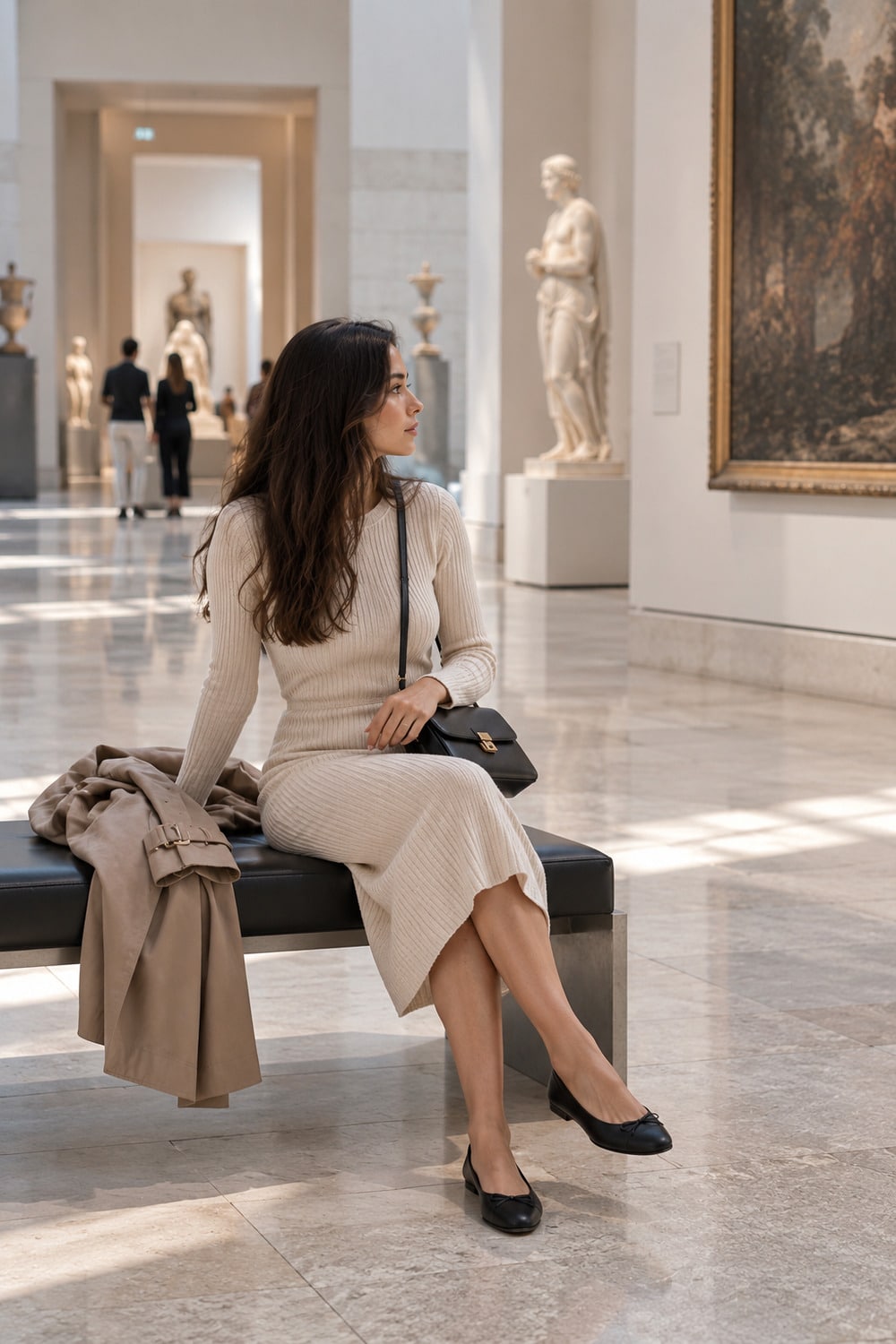
A museum visit creates a different kind of fatigue from a quick city errand. You may walk slowly enough that unsupportive shoes become noticeable, then stand still for ten minutes in front of one room or display. For museum day outfits, start with shoes for long gallery visits that you have already worn for a similar stretch of time: loafers, ballet flats, low boots or clean trainers can all make sense when the fit is familiar.
Give the rest of the outfit a quick “gallery test” before leaving home. Sit for a few minutes, reach into your bag, bend to retie a shoe, and carry your coat over one arm. A skirt that twists on a bench, trousers that drag underfoot, or a sleeve that catches every time you open the bag can be more distracting by the third gallery than it seemed in the mirror.
Outdoor Weather and Indoor Rooms Need Different Layers
Autumn museum day outfits get easier when the outer layer and the indoor outfit have separate jobs. A trench, cropped jacket or light wool coat handles the walk to the museum; underneath, a fine knit, shirt or knit dress should still look complete once the coat is checked or folded over your arm. That is a more useful test than building the entire look around outerwear you may wear for only part of the day.
If you like a sharper silhouette, structured coat style can carry the arrival, but keep the layer beneath it softer and easier to move in. A shirt with relaxed trousers, a thin roll neck with a midi skirt, or a simple dress under a trench gives enough shape without making every layer rigid.
The weather outside can change the weight of those layers without changing the formula. A damp London morning may call for a light trench and closed shoes, while a colder New York afternoon may justify a wool coat over the same indoor base. In either case, avoid an outfit that depends on keeping the coat buttoned to feel finished.
Bag Size Changes How the Whole Visit Feels
Museum bag rules are not universal, so the practical move is to check the venue before choosing the bag. The Met Visitor Guidelines say small backpacks must be worn on the front or carried by hand and large bags should be left at home. The V&A Visiting FAQs state that wheeled luggage and bags larger than 56 × 45 × 21 cm are not allowed in the South Kensington galleries and must go to the cloakroom.
Those policies point to a useful styling choice rather than a universal “small bag” rule. Carry the smallest bag that genuinely fits your day: a compact crossbody for phone and cardholder, a shoulder bag if you prefer easy access, or a slightly roomier option when you need family, accessibility or weather essentials. What matters is that you can keep it close without swinging it behind you near displays.
Texture Can Carry the Fall Mood Without Extra Clutter
Inside a gallery, texture often reads more clearly than a pile of accessories. Fine wool against smooth trousers, suede with crisp cotton, or a ribbed knit beside a plain leather bag gives a fall outfit depth while keeping the silhouette easy to read. A removable scarf is especially useful when you want warmth outdoors without committing to a heavy top layer; Cashmere scarf style offers another way to use that softness around the face.
Colour can stay controlled without becoming neutral by default. Burgundy, olive, navy and chocolate are easy fall bases, but one stronger piece can work just as well. If a saturated knit is the focal point, red sweater style makes the most sense with quieter trousers or denim and simple shoes, so the outfit has one clear visual emphasis rather than several competing ones.
Knitwear Should Hold Its Shape Through the Afternoon
Knitwear can anchor museum day outfits when it stays comfortable after walking, sitting and carrying a coat. Fine-gauge jumpers and knit dresses are easy under outerwear; chunkier cardigans can become the outer layer on a mild day. If you prefer extra length, Longline cardigan outfits can work particularly well with straight trousers or a narrow skirt because the longer line has space to move without tangling around a wide hem.
Watch the details that become annoying over time: sleeves so long they brush against display cases, loose belts that need constant retightening, or fuzzy layers that feel too warm once you are indoors. A museum is one of the rare outings where you notice clothing for hours at a relatively slow pace, so small fit issues have time to become big ones.
Patterned knitwear is still an option if the shape stays simple. colorblocked knitwear works best here when the colour blocks are the main event and the bag, coat and shoes stay comparatively plain. That keeps the outfit expressive without requiring extra jewellery or a second statement layer.
The Outfit Should Still Work at the Museum Cafe
Museum day outfits rarely end at the last gallery. There may be coffee, lunch, a bookshop stop or a walk to another part of the city, and the outfit should not need a reset for each one. Trousers with a fine knit and loafers, a knit dress with low boots, or dark denim with a shirt and relaxed blazer all move easily from exhibition rooms to a table without feeling either overdone or unfinished.
This is also where the “bench test” pays off. If you can sit comfortably, put your coat beside you, keep your bag close and still like the proportions of the outfit without the outer layer, you have solved most of the day’s practical problems. Jeans are completely workable in that equation; a clean straight or relaxed pair usually needs only a good top layer and familiar shoes to feel considered.
Final Thought
A fall museum look is ready when you stop thinking about it once you are inside: comfortable underfoot, complete without the coat, easy to sit in, and simple to carry through security, galleries and a late coffee.
References and Further Reading
- 10 Outfits to Wear for a Day at the Museum
- The Art of Ladylike Museum Day Outfits, Explained
- Visitor Guidelines
- Visiting FAQs
Related Reading