Editorial Note: This lifestyle article is for general editorial inspiration only. It is not financial, medical, legal, travel, safety, or professional advice. Adapt every idea to your personal needs, budget, culture, location, and circumstances.
A longline cardigan is most useful on the in-between days when a coat feels excessive but a bare top feels unfinished. Its extra length changes more than warmth: it adds a second hem, more fabric in motion and a larger block of colour, so the layers underneath need a little thought.
The strongest longline cardigan outfits start with the life the clothes need to handle. A soft cardigan worn through a commute, a desk day and an evening stop needs room to sit, walk and carry a bag comfortably, while the same length over a dress depends on where the two hems meet. Those practical details are what make the layer look settled instead of accidental.
Key Takeaway: Let cardigan length, fabric weight and the shape underneath make one clear silhouette before adding colour or accessories.
Start With the Layer You Will Still Like Indoors
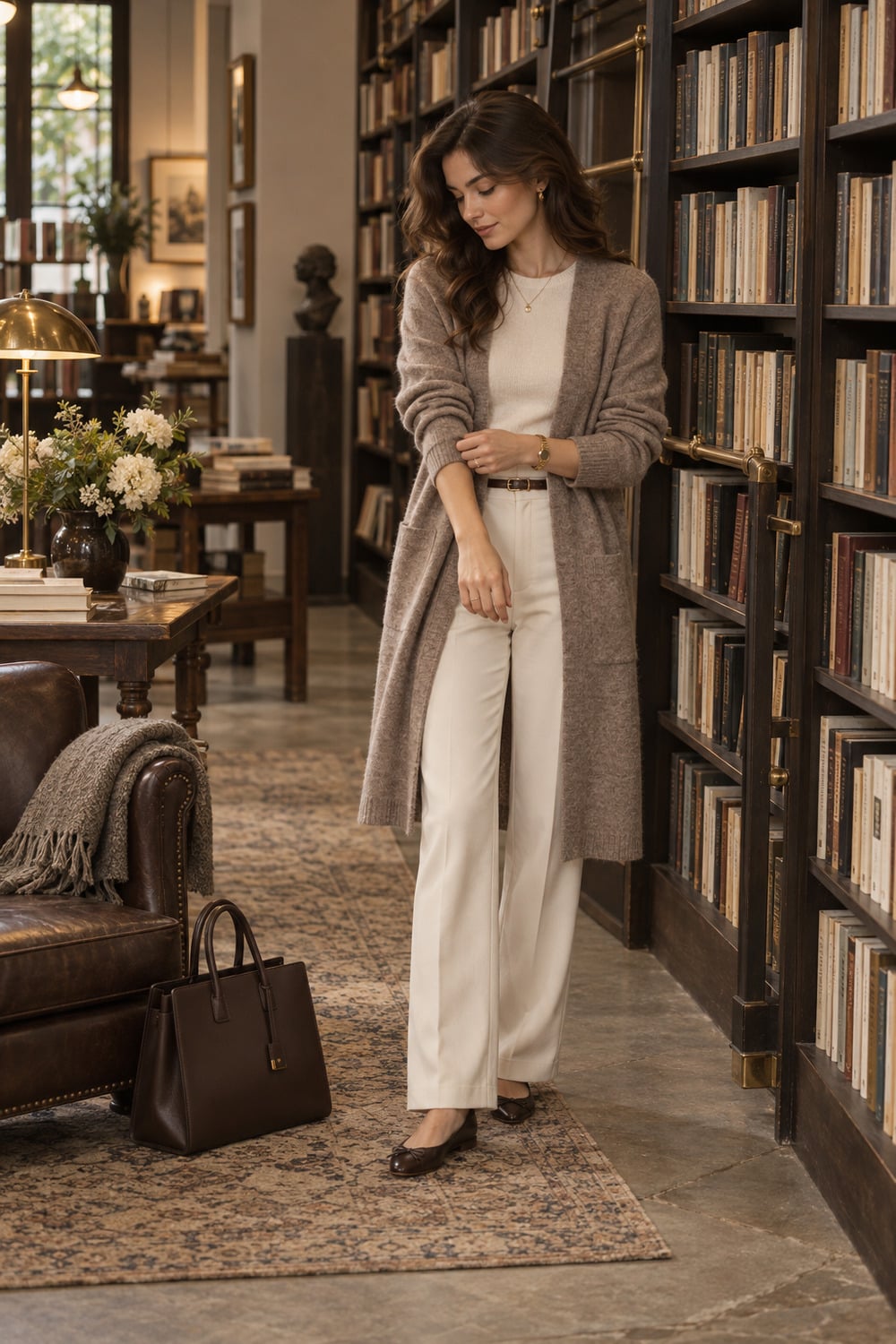
Because a long cardigan often stays on after you arrive, longline cardigan outfits need a base that works without relying on the knit to hide awkward proportions. A fitted tee with straight trousers, a fine knit with dark denim or a close-cut tank with a fluid skirt gives the cardigan a clean surface to frame. If the cardigan comes off, the outfit still feels complete.
An open front creates two vertical edges, so a low-contrast base can keep the eye moving without interruption. Tonal dressing is one route, but it does not have to mean beige from neck to ankle. Navy over washed blue, charcoal over soft grey or chocolate over cream can give the same calm effect while keeping enough contrast to show the layers.
A belt changes the job of the cardigan. Worn under it, a belt defines the base while the knit remains loose; worn over it, the cardigan itself becomes the shaped layer. The second option works best when the knit is thin enough to fold without bunching at the waist and when the pockets do not distort under the belt.
Longline Cardigan Outfits Change With Length and Silhouette
Before judging longline cardigan outfits in the mirror, treat cardigan length and proportion as one question: notice where the hem lands against the strongest line underneath. Mid-thigh cardigans are easy with jeans and trousers because the lower half stays visually continuous. Knee-length versions can also work with a skirt or dress, but the two hems look cleaner when one clearly extends beyond the other instead of ending within a few centimetres of the same point.
For a petite frame, length is not a rule to obey or avoid. The useful question is whether the cardigan overwhelms the visible base. A lighter knit, a defined shoulder and shoes that do not add another bulky break at the ankle can keep more of the outfit visible. If a calf-length cardigan feels heavy, moving the hem upward may solve the issue faster than changing every other piece.
Texture and Colour Need Separate Jobs
Longline cardigan outfits already place a large block of knit across the look, which makes surface texture more noticeable than it would be on a cropped knit. Fine ribbing gives a cleaner line over tailoring, while brushed or chunky yarn creates a softer outline and usually needs a simpler base so the layers do not compete.
When the knit has a pronounced texture, repeat colour quietly elsewhere instead of adding another strong surface. An oatmeal cardigan over ivory with brown shoes, or charcoal over black with a silver-toned detail, gives the eye one main material story. A smoother cardigan leaves more room for a patterned blouse, satin skirt or textured bag.
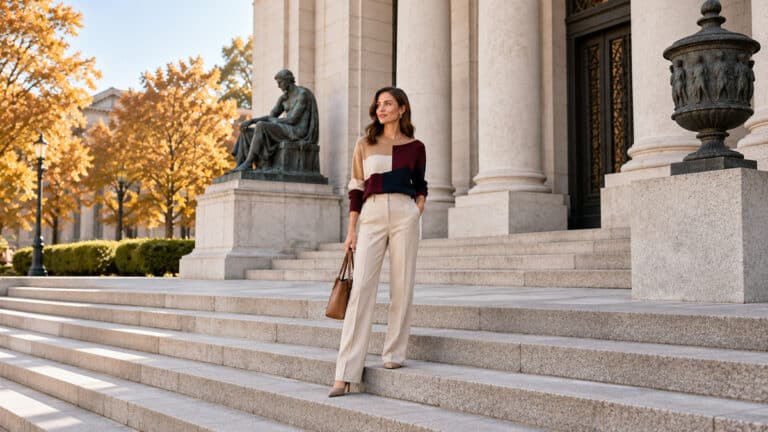
If the cardigan itself carries blocks of colour, keep the surrounding pieces simpler so the longer shape does not become fragmented. The proportions shown in colorblocked knitwear are a useful counterpoint: colour can lead the outfit, but a longline layer needs enough visual breathing room around it.
Neutrals are practical because they repeat easily, not because a long cardigan has to be quiet. Deep green, burgundy or muted blue can work as the largest colour in the look when the top and bottom underneath share a closer value. That approach keeps the cardigan distinct without making every accessory compete for attention.
Trousers and Denim Need a Clear Shape
Straight jeans are the easiest starting point, but wide-leg trousers do not automatically clash with longline cardigan outfits. The deciding detail is where the volume sits. A fine or fluid cardigan can fall beside a wider trouser leg, especially over a compact top; a thick, oversized knit with equally bulky trousers can make the middle of the outfit feel dense. If that happens, reduce fabric volume in one layer instead of defaulting to a tighter jean.
Shoes should finish the trouser line without becoming a separate heavy block. Loafers, ballet flats and streamlined ankle boots are simple choices when hems are full length. With cropped trousers, a chunkier shoe can be deliberate because the ankle break is already visible. This is less about a single correct shoe and more about deciding where you want the final visual break to occur.
Structure Can Come From One Detail
The softness of knitwear makes one structured element especially useful when longline cardigan outfits need a firmer edge. A firm shoulder bag, a crisp trouser crease, a narrow belt or a loafer with a defined sole can give the outfit an edge without turning the cardigan into imitation tailoring. Choose the detail that suits what you are actually doing; a hard-edged tote may look sharp but can drag on a loose cardigan sleeve during a crowded commute.
For a relaxed work setting, styling a long cardigan as the third layer works when the rest of the outfit is tidy and the dress code allows knitwear. The calm, controlled combinations in soft power dressing offer a useful reference for pairing softness with one precise detail. In a setting that specifically calls for a blazer or jacket, keep the cardigan as an extra layer instead of treating it as an automatic substitute.
Jewellery does not need to carry the whole finish. Small earrings or a watch can be enough when the cardigan has visible ribbing, large pockets or a strong collar. If the knit is very plain, a scarf or brooch can take on more presence because it is not competing with texture at the neckline.
Dresses Need a Deliberate Hem Relationship
A slip dress can make longline cardigan outfits work because the two fabrics do different things: the dress falls close to the body while the knit adds softness around it. A knitted column dress creates a more continuous surface, so the cardigan needs a slightly different edge through colour, ribbing or a visible opening. The examples in knit dress style can help when you want the dress itself to carry the shape.
A solid cardigan with a printed dress can calm the number of visual elements, but check the hem from the side as well as the front. If the cardigan stops at the fullest part of a gathered skirt, the layers can stack into one bulky band. Moving to a shorter cardigan, a straighter dress or a more fluid knit changes that relationship without requiring a completely different outfit.
Footwear can shift the dress pairing from light to grounded. Ballet flats keep more ankle visible, while boots add another vertical block below the cardigan. Neither is automatically better; compare the cardigan hem, dress hem and boot shaft together. Three endings clustered in the same area can look crowded, while clear spacing between them reads more deliberately.
The Real Test Happens Away From the Mirror
A full-length mirror is only the first test for longline cardigan outfits; they should also survive sitting, carrying and walking. Sit down before leaving home to see whether the hem pools under you, whether side pockets pull forward and whether the front catches on chair arms. Then try the bag you actually plan to carry. A crossbody strap can compress a thick knit, while a shoulder bag may repeatedly push one side of an open cardigan backward.
Once those practical points are settled, one personal detail is enough to stop a neutral outfit feeling anonymous. A silk scarf, small brooch or hair ribbon can do that without changing the proportions; Ribbon detail style shows how a small accent can sit beside knitwear without becoming the whole theme. The best finishing choice is the one that stays comfortable after an hour of real wear, not only for the first photograph.
Final Thought
Longline cardigan outfits work when their length has a clear relationship with the layers beneath them and the fabric suits the movement of the day. Get those two decisions right first, and the colour, shoes and finishing details become much easier to choose.
References and Further Reading
- 15 Ways to Wear a Long Cardigan Through the Dead of Winter
- How to Style a Long Cardigan With Everything in Your Closet This Winter
- How to Style Cardigans for Autumn, According to 6 It Girls
- Kate Garraway’s printed midi dress and cream cardigan made the perfect cosy outfit for her day of gardening
Related Reading