Editorial Note: This lifestyle article is for general editorial inspiration only. It is not financial, medical, legal, travel, safety, or professional advice. Adapt every idea to your personal needs, budget, culture, location, and circumstances.
A piece of colorblocked knitwear can carry most of an early fall outfit before a coat is even involved. The useful question is not whether the colors are bold; it is whether the blocks already give you a workable base, an accent and enough breathing room for the clothes around them.
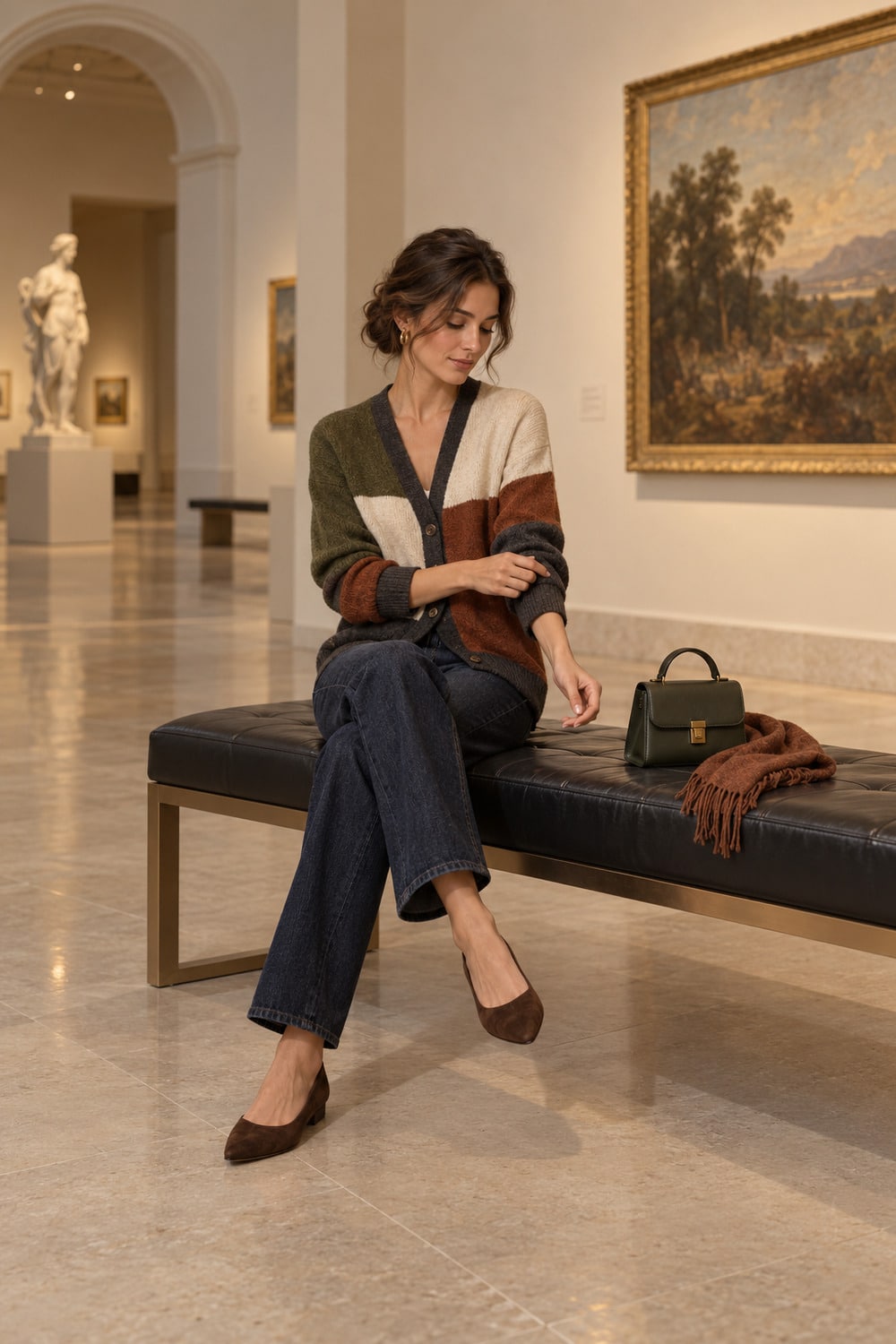
Colorblocked knitwear is easiest to repeat when you read it as a small palette instead of a statement that needs extra styling. A camel body with burgundy sleeves asks for different support than a cream jumper divided by cobalt and charcoal, even if both contain the same number of colors.
That makes placement as important as shade. Color near the face, across the shoulders or at the hem changes where the eye lands, while the weight and surface of the yarn decide whether those boundaries look crisp or softly blended.
Key Takeaway: Colorblocked knitwear works best when the largest color anchors the outfit while smaller blocks stay secondary and need no exact matching.
Colorblocked Knitwear Starts With the Largest Color
Start by finding the shade that occupies the most visual space. If a cardigan is mostly oatmeal with burgundy sleeves and a narrow olive band, oatmeal is the base; it can sit easily above dark denim, camel trousers or a cream skirt without asking the smaller colors to be repeated everywhere. On a mostly navy sweater with one broad red panel, navy can do the same job.
This is also a useful buying test. Before adding a new knit, picture the fall sweater outfits it could make with the bottoms you already reach for most. If its largest block works with at least a couple of those pieces, the sweater has several natural routes into your wardrobe. If every combination requires a new skirt, shoe or bag to make sense, the palette may be less useful than it looks on its own.
A tailored trouser or clean skirt can give a graphic knit a firmer outline without adding more visual activity. If that is the direction you prefer, soft power dressing offers a useful reference for sharper lines around a softer sweater.
Where the Color Sits Changes the Effect
Two sweaters can use identical colors and still feel completely different because the blocks sit in different places. A bright yoke or collar pulls attention upward; contrast cuffs create smaller flashes of color as the hands move; a dark lower panel can make the hem feel visually heavier than the shoulders. Long vertical panels tend to read differently from wide horizontal bands because they divide the torso in another direction.
Use that placement to decide what should stay quiet. If the sweater already has a strong block across the shoulders, a heavily detailed necklace or patterned scarf can crowd the same area. If most of the color is lower on the body, a simple earring or clean neckline leaves the upper half open. The point is not to disguise the knit but to avoid stacking several focal points in one zone.
Texture Decides How Sharp the Blocks Feel
Knitwear texture helps determine how sharp the blocks feel: fine gauge wool, smooth cotton and tightly ribbed knits keep color boundaries clear, so even a restrained palette can look graphic. Brushed yarns, boucle surfaces and fuzzier knits soften the edge between one shade and the next. A chunky sweater with high contrast blocks can therefore feel visually fuller than a slim knit using equally strong colors.
That difference matters when you choose the bottom half. A dense, fuzzy sweater often needs less texture underneath, while a smoother knit can sit comfortably beside corduroy, satin or washed denim. Simple does not have to mean plain; it means giving the eye somewhere to rest after the sweater has done its work.
Small details can still belong in the outfit when they occupy a different scale from the blocks. A narrow bow or slim belt, for example, reads as a finishing note rather than another large color area. The same restraint is useful in ribbon detail style, where a compact accent works better than several competing decorations.
Accessories Can Echo a Shade Without Matching It
When colorblocked knitwear combines several shades, an accessory does not need to duplicate any one sweater color exactly. Burgundy can be answered by oxblood leather, cream by warm ivory and olive by a muted moss tone. Keeping the undertone related is often enough to make the choice feel connected, and it avoids the slightly forced look of trying to source an exact shade across different materials.
Scale matters here too. A small bag, belt, flat or sock can repeat a secondary block without turning the outfit into a color exercise. If colorful knitwear already contains several large saturated areas, neutral accessories may be the better decision. The sweater has already supplied the contrast, so nothing is missing when the rest stays restrained.
Outer Layers Edit the Visible Color
Early fall rarely requires the same amount of coverage all day, which makes outerwear useful as an editing device as well as a warm layer. An open blazer can expose the central blocks of a sweater, while a buttoned coat may leave only the collar and cuffs visible. If you prefer warmth from one continuous knitted silhouette, knit dress style takes that idea in a different direction.
A neutral coat is especially useful when the sweater becomes more graphic than you want for a commute or evening setting. Camel, navy, charcoal or deep brown can frame a bright knit without asking it to disappear. For damp September weather, classic trench coat style shows how a cleaner outer layer can keep the visible color concentrated through the center of the outfit.
The Knit Should Work With More Than One Outfit
The most useful colorblocked knitwear earns its space through repeat combinations, not through one perfect look. Try a simple wardrobe check: the knit should make sense with more than one bottom silhouette and at least one outer layer you already own. That gives you room to move between jeans, trousers or a skirt without rebuilding the palette each time.
Shape affects that repeat value. A cropped cardigan may sit neatly with higher waistlines but become awkward over lower rise trousers; a long relaxed sweater may be easy with slim bottoms yet bulky under a fitted coat. Fine gauge pieces usually layer under jackets more easily, while a heavier knit may need to act as the outermost piece on mild days.
If you decide the wardrobe already has enough solid color, pattern can provide a smaller dose of contrast instead. A controlled check around a plain coat or knit creates a different focal point, and plaid scarf style is a useful alternative when you want fall color without committing to a multicolored sweater.
Final Thought
Colorblocked knitwear feels calmer when you stop treating every shade as a separate styling task. Let the largest block set the base, notice where the strongest color sits, and use texture or outerwear to adjust how much contrast is visible; the sweater can then carry the color without carrying the whole outfit.
References and Further Reading
- 13 Fall 2026 Styling Tricks to Try This Spring
- The Fall Sweater Trends We’re Investing In This Season
- 10 Colour Trends Setting The Tone In 2026
- The Bold Knitwear Styling Trick To Try This Winter
Related Reading