Editorial Note: This article explores cultural lifestyle inspiration in an editorial way. It does not claim to represent every woman, country, region, or personal experience. WorldsLadies avoids stereotypes and presents these ideas as gentle, adaptable lifestyle reflections.
On a wet weekday at Nørreport, hygge style appears first as a practical Copenhagen rhythm, before any candle is lit. Trains, metro entrances, buses, bicycle parking and a broad public square meet in one place, so coats, bags, shoes and daily timing all answer to movement. The station’s 2015 redesign makes a stronger starting point than a generic picture of pale furniture because it shows how comfort can be built into ordinary circulation.
This feature follows that practical line from the station into a contemporary Copenhagen home: first through cycling, then through low winter light, storage, color and a table arranged for an unforced evening. The focus is hygge style through Copenhagen everyday design, not a portrait of Danish women as a single group. Nørreport, municipal cycling guidance and a few documented design trends provide the setting; other Danish cities, rural areas, households and personal routines may work differently.
The central question is simple: what remains useful when hygge is separated from the international shopping list of blankets, candles and neutral décor? In Copenhagen, the answer can be read through function. A lamp earns its place by improving a dark corner, a coat works because it handles wind and rain, and a gathering feels considered because the room allows people to sit without turning hospitality into a display.
Key Takeaway: Practical hygge ideas in Copenhagen begin with useful movement, layered light and rooms arranged for ordinary company.
Nørreport Sets the Practical Frame
Nørreport Station is Denmark’s busiest rail hub, and the Danish Architecture Center describes its redesign as an attempt to integrate transport with public life. Roughly 250,000 people pass through the site daily. That scale matters because the project does not treat ease as decoration: transparent pavilions clarify movement, open forecourts improve sightlines, and the square must absorb the repeated pressure of arrivals, transfers and bicycle traffic.
The sunken bicycle beds are especially instructive. Lowering parking areas by about forty centimetres increased capacity to around 2,500 bicycles while keeping views across the plaza open. White concrete, granite, glass and stainless steel carry heavy use without turning the forecourt into a visual obstacle course. On the sloped roofs, low planting helps take runoff from sudden cloudbursts. Each choice links appearance to a task that the inner-city site actually has to perform.
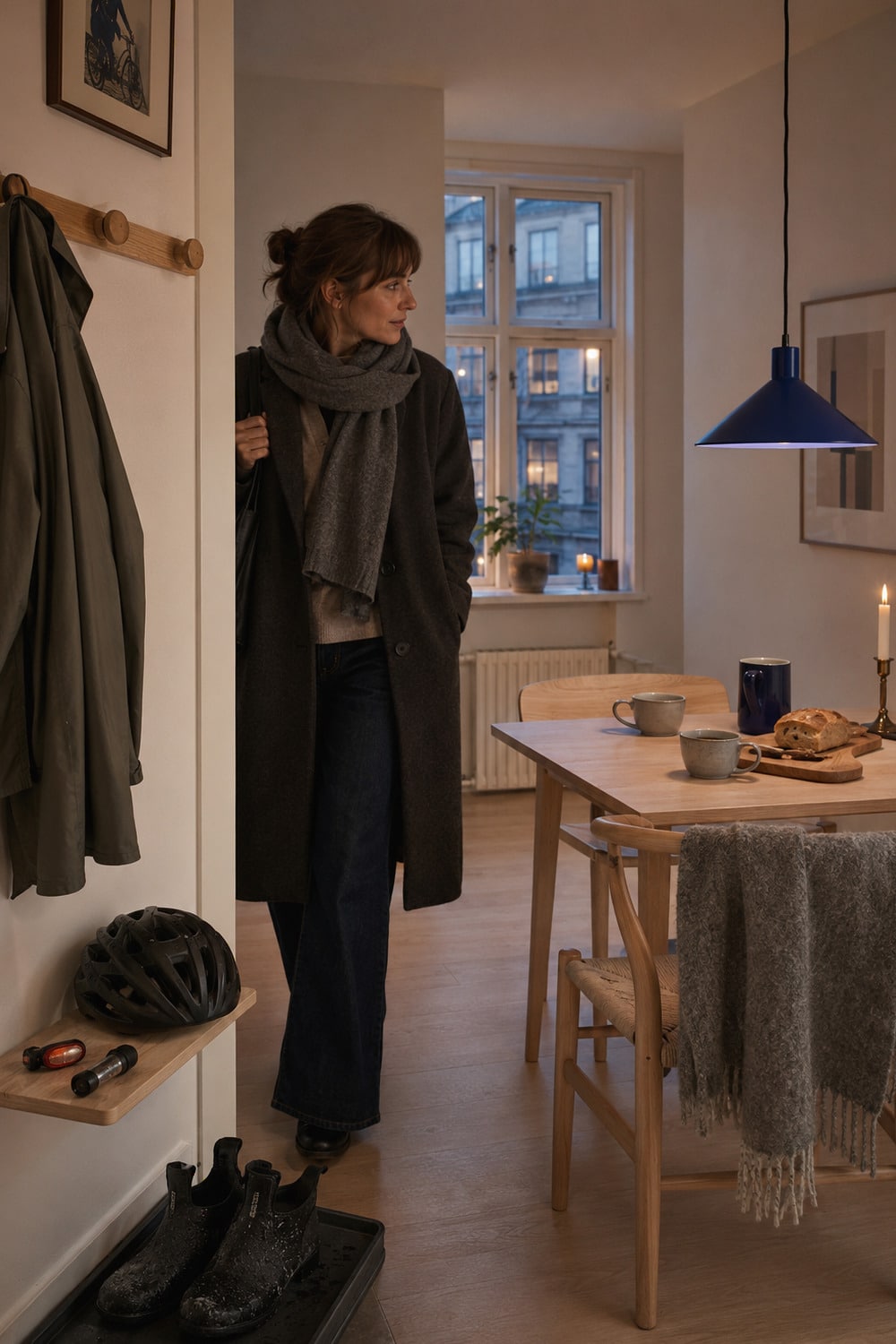
That sequence gives hygge style a practical indoor form without copying a station. A narrow Copenhagen entryway may need hooks at several heights, a tray for wet shoes, a place for bicycle lights and one clear route to the living area. The design question is not whether the hall looks minimal in a photograph. It is whether a raincoat can dry, a bag can be set down and the door can open freely when two people arrive at once. At Nørreport, that practicality is visible in the clear gap kept between parked bicycles, passing feet and station entrances during the weekday rush.
Cycling Changes What Clothing Must Do
The City of Copenhagen’s cycling guidance describes a system in which bicycles connect with metro, trains and harbour buses, though rush-hour restrictions apply in specific places such as Nørreport. It also requires bike-lane use, hand signals, lights after dark and attention to pedestrians. Within this setting, practical style begins with visibility and movement: a coat cannot block a rider’s hands, a trouser hem must stay clear of the chain, and a shoulder bag should remain stable through a turn.
These requirements do not create a single Copenhagen uniform. Weather, mobility, work and access vary, and some residents do not cycle at all. The transferable principle is to let the route edit the wardrobe. For a wet commute, that may mean a breathable outer layer over a knit, shoes with grip and a small reflective detail that works after dusk. Where protected cycle lanes are absent, the same principle can support walking or public transport instead of imitating the bicycle itself.
Low Light Shapes the Room
During Copenhagen’s darker months, hygge style works through layered lighting because one ceiling fixture rarely does every job well. A lamp beside a chair, a lower pool of light over the table and a clear source near the entry create separate zones without requiring a large room. Candles may be part of an evening, but they cannot replace task lighting where someone reads, cooks or searches for keys. The useful quality is the layering, not the number of decorative objects.
Materials change how those layers register. Oak, wool, linen, ceramic and painted metal each return light differently, so a compact room can feel varied without being crowded. A matte wall softens glare, a glazed cup catches a brighter point, and a wool throw adds depth even when the palette stays restrained. These are observable design functions, not proof that one material carries a fixed Danish meaning.
A pale timber room can resemble the calm palette explored in Swedish women lifestyle, yet the practical details here come from Copenhagen: bicycle lights near the door, outerwear that needs to dry and lamps switched on before an evening meal. The comparison is visual, while the setting remains specific to the route from Nørreport into a city home.
In a smaller space, hygge style may emerge through subtraction with a purpose. Clearing the surface beside a lamp gives a cup and book somewhere to rest; moving a chair away from the main path prevents evening conversation from blocking the room. Hygge becomes legible through use: the corner is ready because its light, seat and surface support what actually happens there.
Color Keeps Minimalism From Becoming a Costume
Online décor coverage has used the label “Danish pastel” for a look that appeared around 2020, combining light furniture with pink, mint, butter yellow, curved accessories and playful desk objects. That trend is useful as evidence of how quickly a place name can become an exportable visual package. It should not be mistaken for a standard Copenhagen interior or for a practice shared across Danish households.
Still, the trend exposes a helpful correction to the beige stereotype. A Copenhagen room organized around pale wood and clear circulation can hold a cobalt lamp, a rose-colored chair or a striped textile without losing its practical structure. Color works best when it helps a zone read clearly: a bright tray gathers small objects near the door, a contrasting cushion marks the chair used for reading, and patterned fabric gives a plain dining bench more presence.
The same restraint applies to vintage and new pieces. Nørreport’s redesign combines several materials because each serves the plaza; a home can also mix eras when every object has a job. A repaired chair, a contemporary lamp and an ordinary storage box need no invented cultural symbolism. Their relationship is established by scale, maintenance and use, which keeps “Danish style” from becoming a costume assembled for the camera.
The Shared Table Stays Modest in Scale
Hygge style is commonly presented through comfort and easy company, but a Copenhagen table does not need a prescribed menu or formal tablescape to support that atmosphere. In a compact apartment, the practical decisions come first: enough light to see faces and food, chairs that can be pulled out without hitting the wall, serving dishes that fit the surface and a plan simple enough that the host can remain seated for part of the evening.
A shared table can carry a very different rhythm from the generous hosting described in Lebanese women lifestyle. In this Copenhagen-centered setting, the useful move is to match the meal to the room: soup in one pot, bread on a board, coffee after the plates are cleared, or a bakery cake brought to the table without apology. The point is not austerity; it is removing tasks that pull attention away from the people present.
Hygge Style Without the Shopping List
During the 2016 publishing surge, hygge style was repeatedly packaged through books, retail displays and seasonal products. Critical coverage at the time noted how easily a context-dependent word could be reduced to cashmere, candles and purchasable comfort. That history is a useful boundary for a Copenhagen lifestyle feature: buying the visual signs does not reproduce the transport network, housing conditions, social relationships or personal histories that shape a real evening in the city.
A better adaptation starts with the function visible at Nørreport. Keep the route clear. Give frequently used objects a stable place. Add light at the height where a task happens. Choose outerwear for the weather and mode of travel. Let color identify a zone instead of covering every surface. These decisions can be adjusted in a hot climate, a car-dependent suburb or a shared household because they preserve purpose while changing materials and scale.
The limits matter as much as the ideas. Copenhagen is not Denmark in miniature, and one station or apartment cannot stand for all city residents. Rent, space, disability, caregiving, work schedules and personal taste change what is possible. The strongest version of hygge therefore remains modest: a word for a particular quality of time, supported here by a city’s practical design, but never a test of whether a home or person is living correctly.
Final Thought
Hygge style becomes clearer when the route begins at Nørreport and ends in a room prepared for real use. The useful thread is not a national personality or a shopping style; it is the connection between movement, weather, light, storage and company. Preserve that connection, and the result can feel warm without pretending to reproduce Copenhagen somewhere else.
References and Further Reading
- What Is Hygge?
- Danish Pastel Takes a Colorful Twist on Scandinavian Style
- Cycling in Copenhagen
- Nørreport Station
- The Danish concept of ‘hygge’ – and why it’s their latest successful export
- The hygge conspiracy
Related Reading