Editorial Note: This lifestyle article is for general editorial inspiration only. It is not financial, medical, legal, travel, safety, or professional advice. Adapt every idea to your personal needs, budget, culture, location, and circumstances.
Late August can make a summer to fall capsule wardrobe feel oddly divided. Linen trousers and open shoes still suit a hot afternoon, while a cool office, a breezy evening, or a wet morning calls for coverage that does not feel like winter dressing.
A summer to fall capsule wardrobe works best as a bridge between those conditions. Its size depends on your routine, laundry rhythm, climate, dress code, and the occasions already on your calendar, so a fixed item count is less useful than a set of clothes that can form both warm and cooler versions of the same outfit.
Start with what you already wear, then test each addition against temperature, movement, footwear, and real outfit combinations. This creates a smaller transitional capsule wardrobe with fewer stranded pieces and clearer reasons for anything new.
Key Takeaway: Build from repeatable warm-weather outfits, then add removable layers, closed-toe shoes, and deeper accents only where your real week needs them.
Let Your Calendar Shape the Summer to Fall Capsule Wardrobe
Begin with the next week or two, not an imaginary autumn. Mark the days that involve commuting, long walks, air-conditioned rooms, school runs, dinners, remote work, or time outdoors. Then pull complete outfits for those situations from the clothes already in rotation. Useful late summer outfit planning is shaped by repeated needs, not by a universal wardrobe total.
Give every chosen outfit a warm version and a cooler version. A shirt with trousers might use sandals at midday, then gain a cardigan and loafers after sunset. A dress may need only a light jacket and a different bag. The existing end of summer style ideas are most helpful when treated as starting points that can accept one practical layer.
Set aside pieces that demand a very specific bra, shoe, hem length, or weather condition unless that combination appears often in your life. An August wardrobe reset can expose these friction points before they become capsule filler. Special-occasion clothes can remain outside the edit; a working capsule does not have to represent every garment you own.
A Breathable Base Handles Lingering Heat
The base layer should still feel right on the warmest likely day. A crisp cotton shirt that can be worn buttoned or open, a comfortable tee or tank, relaxed trousers, clean denim, and a dress or skirt give the wardrobe enough shape without forcing heavy autumn fabric too early. Choose the versions that already sit well, move easily, and work with the underwear you actually use.
Colour does not have to be limited to beige and black. A compact palette only needs enough overlap for the tops, bottoms, shoes, and layers to meet without argument. Ivory with navy, faded denim with chocolate, or olive with warm white can all work; a print belongs when at least one of its colours connects to the rest of the edit. This keeps a summer to fall capsule wardrobe coherent without draining it of personality.
Movable Layers Cover the Temperature Swing
The summer to fall capsule wardrobe treats warmth as something you can add and remove during the day. The first layer might be an open shirt, fine cardigan, or light knit that fits into a tote. A more structured option, such as an unlined blazer, soft utility jacket, or vest, can handle work and evening plans. A rain layer earns space only when the local forecast and your routine make it useful.
The point is to choose the lightest layer that solves the recurring problem. A sleeveless shape gives the torso more structure without covering the arms, which is why modern vest style can carry into early autumn with trousers or a midi skirt. In a hot place with cold interiors, a packable cardigan may matter more; in changeable, damp weather, a light jacket with room underneath may do more work.
Try every layer over the bulkiest base you plan to wear, then check whether the sleeves pull, the hem bunches, or the bag becomes awkward. A thick knit may feel seasonally appealing but reduce the number of workable combinations. Keep it only when you expect to wear it for long enough to justify the lost flexibility.
Shoes Set the Seasonal Pace
Closed-toe shoes can introduce autumn before the rest of the outfit changes. A loafer adds coverage and works with denim, trousers, and many skirts; a ballet flat or slingback keeps the line lighter; a clean sneaker may suit a walking-heavy day better. Keep sandals available while the temperature supports them, and test every proposed shoe with the actual trouser hems, dress lengths, socks, commute, and wet-weather conditions it will meet.
Autumn Colour Can Arrive Through Small Details
A deeper bag, belt, scarf, or piece of jewellery can help a summer to fall capsule wardrobe change season without retiring its breathable base. Chocolate, burgundy, olive, tobacco, and ink navy are easy to introduce in small areas, but they are not compulsory. The useful colour is the one that repeats something already present and works with the shoes you intend to wear.
A familiar shirt dress may need only the proportion change shown in statement belt style, while a plain knit and trousers can take a stronger focal point through statement ring style. Use one noticeable detail at a time when several textures are already present; otherwise the transition can feel busier than the summer outfit it replaced.
Trying Outfits at Home Exposes Weak Links
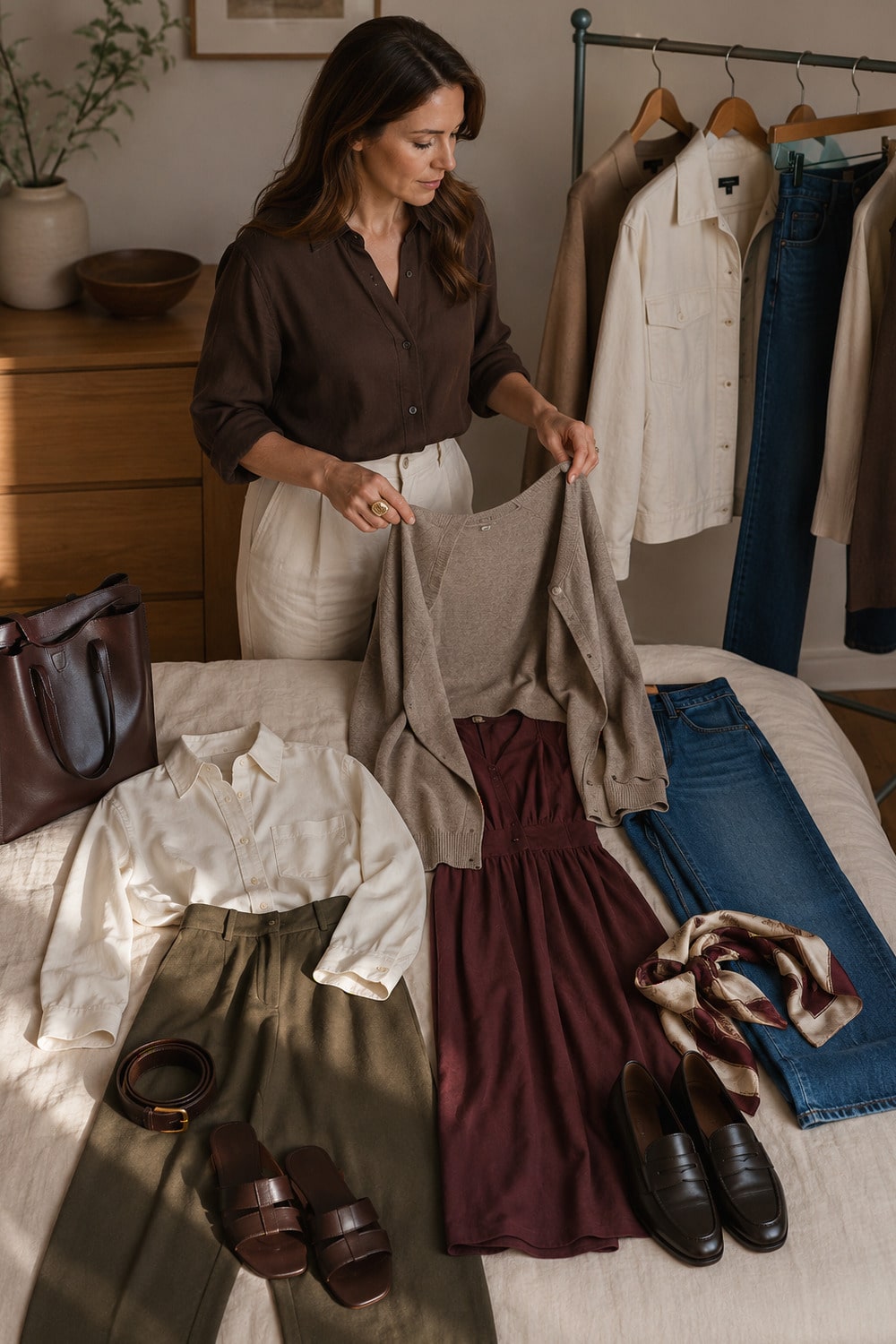
Build several outfit families on the bed or rail, then make a warm and cool version of each. Useful families might include shirt with trousers and flats, dress with cardigan and closed-toe shoes, or tee with skirt and light jacket. A piece earns a strong place when it works in more than one family and does not require a single fragile pairing to make sense.
Wear each combination for a few minutes rather than judging it on a hanger. Sit down, lift a bag, walk in the shoes, and check the outfit in daylight. Small annoyances become obvious: a trouser hem catches under a loafer, a jacket will not close over the knit, or the only suitable bag cannot hold the layer you expect to remove.
Delay shopping until the same gap appears in more than one tested outfit. That repeated gap identifies the next useful addition to a summer to fall capsule wardrobe, whether it is a packable layer, a closed-toe shoe, or a top that connects two bottoms. Laundry frequency, body changes, mobility needs, uniforms, cultural dress, and special events can all make an uneven capsule sensible. The purpose is reliable dressing across a short seasonal handover, not a perfectly balanced inventory.
Final Thought
Keep the linen trousers, dresses, shirts, and sandals that still suit the forecast, then add only the layer, shoe, or accessory that completes their cooler-weather version. When those clothes can move through a warm afternoon, a cool room, and an early-autumn evening without a full change, the seasonal bridge is working.
References and Further Reading
- Rework Your Wardrobe for Transitional Weather With These 11 September Outfit Ideas
- Here’s What to Wear in 70-Degree Weather
- 15 Summer-to-Autumn Transitional Outfit Ideas to Copy in 2025
- How to build an autumn capsule wardrobe for 2025
Related Reading