
Editorial Note: This article explores cultural lifestyle inspiration in an editorial way. It does not claim to represent every woman, country, region, or personal experience. WorldsLadies avoids stereotypes and presents these ideas as gentle, adaptable lifestyle reflections.
In Dakar, “Senegalese women lifestyle” is useful here only as a city-specific lens on places where clothes are actually made and adjusted. A single-room atelier in Ngor, fabric shops around the city, the Plateau streets used by recent fashion editorials, and the workshops and cultural venues that host designers all point toward a practical question: what changes when clothing is treated as a process of choosing, cutting, fitting and reworking instead of a ready-made national image?
The scope stays with Dakar from the early 2020s to 2026 and with documented makers, institutions, markets and creative events. It does not turn the capital into a stand-in for Senegal, and it does not treat a garment, color or social gesture as a rule for Senegalese women. The phrase Dakar style and craft is used here for a city-specific creative context, not for a personality type.
The strongest idea to carry forward from this city-specific Senegalese women lifestyle frame is therefore functional. Look at where a piece is made, what work goes into its shape, how color is edited against a real street or room, and whether a craft object still has a maker and setting attached to it. That method preserves the original article’s interest in style, craft and social warmth while replacing broad cultural praise with choices that can be seen and described.
Key Takeaway: In Dakar, the most useful lifestyle inspiration comes from following the work behind a garment or object, then adapting its function without turning the city into a national template.
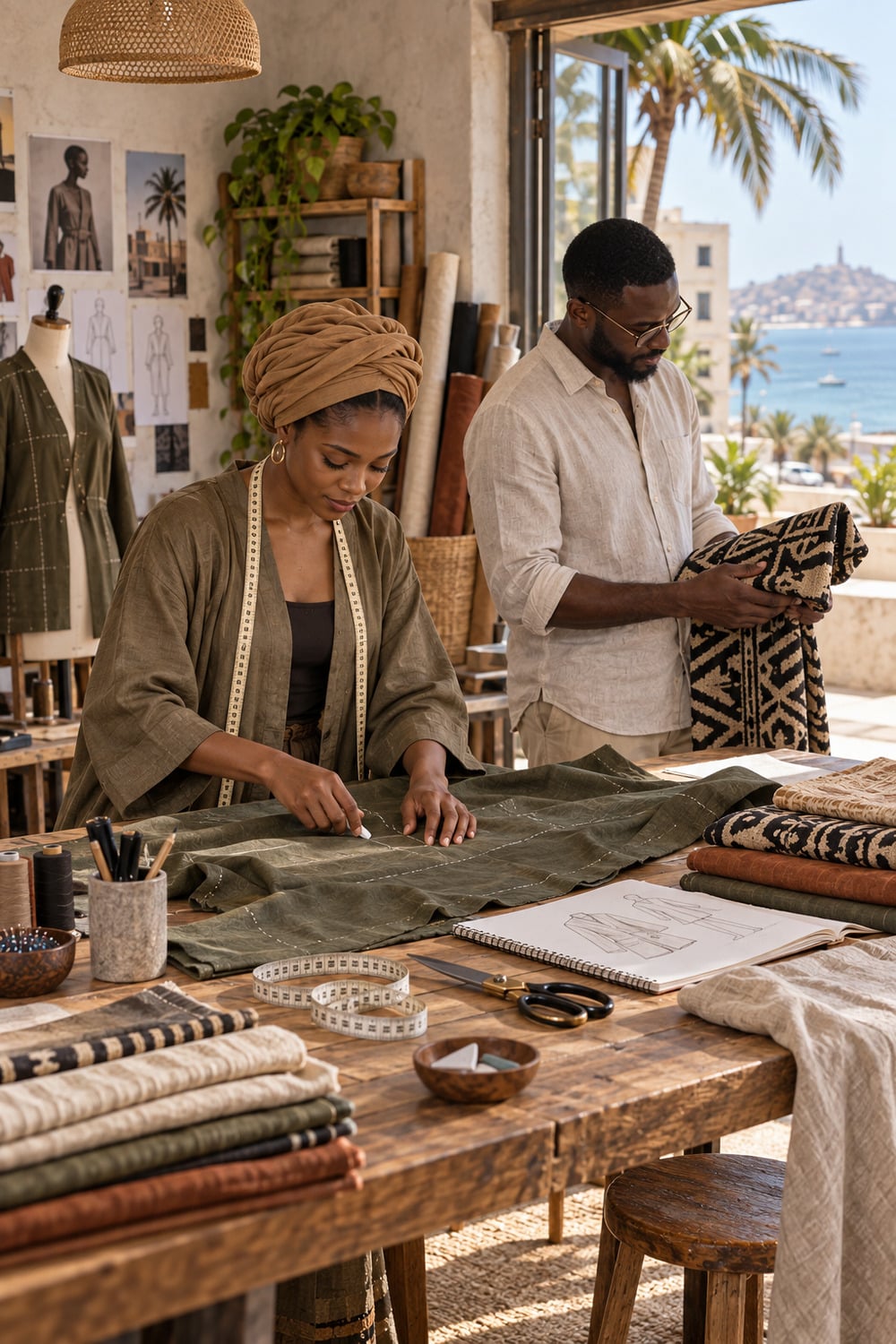
Senegalese Women Lifestyle Through Ngor Tailoring in Dakar
In Ngor, a 2022 report followed tailor Bada Seck inside a compact atelier where finished jackets shared space with dresses, fabric bags and an idle sewing machine. Clients could bring fabric and ask for made-to-measure clothing in different forms, so the useful detail is not a claim that Dakar has one look. Within this city-specific Senegalese women lifestyle frame, Dakar tailoring and craft become a sequence of decisions: fabric arrives, a cut is chosen, a body is measured, and the garment is finished for a particular person and occasion.
That sequence gives the article a more precise version of “presentation.” A reader outside Dakar can borrow the fitting logic without borrowing a culturally specific garment: shorten a sleeve after trying it in motion, choose a fabric weight that suits the intended use, or ask a local tailor to repair a shape that almost works. Ngor matters here because the documented atelier makes the labor visible. The lesson comes from commissioning and adjustment, not from copying a silhouette.
Color becomes easier to handle when the garment has a job. A strong fabric selected for a jacket can carry more visual weight than a small accessory, while a patterned piece may need a quieter neighboring layer. For a separate editorial treatment of confident color, Nigerian women lifestyle can be read alongside this Dakar example; the useful comparison is how a palette is edited around a real garment, not whether one country is more colorful than another.
Plateau Color Works Through Selection
A 2025 fashion shoot in Dakar’s Plateau district used local labels and secondhand pieces against streets, buildings, markets and the shoreline. Because the editorial named its locations and styling sources, it keeps this Senegalese women lifestyle reading city-specific while discussing color instead of calling an entire city “bold.” The practical unit is the outfit in a particular setting: one saturated surface, one textured garment, one repeated tone, or a deliberate contrast between clothing and architecture.
For everyday use, the transferable method is a two-step edit. First choose the garment that carries the pattern or strongest hue; then remove any second item that competes without adding function. In Plateau, the photographed looks were constructed for a specific editorial and cannot stand for normal dress across Dakar. That boundary is useful because it turns inspiration into an editing exercise. It also keeps the eye on styling decisions instead of using photographed people to define a whole population.
Soumbedioune Makes Craft Visible
At Soumbedioune craft market, near the Corniche and the Medina area, the Senegalese women lifestyle scope narrows to a 2024 Dakar Biennale OFF project that brought five artisans into a design exhibition in the market’s central square. The participants included makers working in sculpture, jewelry, leather and upholstery. The important contemporary detail is the encounter between an existing craft workplace and a temporary design platform, not a claim that every handmade object in Senegal carries the same meaning.
That setting suggests a practical buying rule: keep the maker and use attached to the object. A leather piece can be judged by stitching, closure and repairability; an upholstered object by construction and wear; a small metal object by finish and how it will be handled. If handwork is the part that matters, Slovak women lifestyle offers another craft-focused reading. The comparison should stop at process—materials, repair, finishing and maker visibility—because the cultural histories behind different crafts are not interchangeable.
Soumbedioune also corrects the idea that craft belongs only in a heritage display. In the documented exhibition, makers were asked to interpret a shared design brief and show work in a contemporary event. That gives readers a concrete distinction between preservation and use: an object may enter a new format without becoming detached from the person who made it. When adapting this idea at home, display information about a maker or workshop where possible, and avoid inventing symbolism for color, pattern or material.
Dakar Training Keeps Design Practical
Dakar’s design infrastructure gives this Senegalese women lifestyle subject a city-specific frame beyond runway coverage. The Ecole nationale des arts lists training in visual arts and an environmental-arts specialization that includes architectural, artisanal and textile-related design; its classes and workshops are located in the Fann area, with the direction in Nord Liberté. This does not prove what ordinary households wear. It does show that design in the city can be studied through skills, disciplines and workshop practice instead of street-style mythology.
A second institutional layer appears in the Mode Sénégal initiative launched in 2020, which connected designers through a magazine and educational activity. Its published material presents work from dozens of designers and uses specific Dakar settings such as city streets, Yarakh and the Mamelles area. The useful point is plurality: several makers, several locations and several material approaches appear side by side. No single designer needs to carry the burden of representing Senegalese fashion as a whole.
For readers, this changes the shopping question from “Does this look culturally authentic?” to “What can I verify about construction and context?” Check whether a seller names the material, whether the cut suits the intended movement, and whether care instructions match the fabric. A craft comparison elsewhere should use the same discipline. Cypriot women lifestyle may offer another home-and-lifestyle context, but the Dakar material remains anchored to its own institutions, workshops and contemporary design settings.
Creative Events Do Not Equal Everyday Life
Under the city scope used here, Senegalese women lifestyle is observed through public design stages such as Dakar Fashion Week, the Dakar Biennale and a 2025 styling competition at Centre culturel Blaise Senghor, each serving different participants and purposes. The styling competition brought young designers from Senegal’s regions to a Dakar venue, while the Biennale OFF project at Soumbedioune connected a small group of artisans with curators. These events show routes into visibility; they do not measure what most residents buy, wear or make on an ordinary day.
That distinction matters whenever a runway or photo shoot is used as lifestyle inspiration. Event clothing may be designed for a camera, a collection or a judging panel, while an atelier order begins with a client and a practical request. A respectful wardrobe edit can keep both categories separate: use runway images to notice proportion or color relationships, then test the idea against the movement, climate and maintenance demands of your own setting. Dakar remains the source of the observation, not a costume board.
Warmth Without Turning Hospitality Into a Trait
The original article linked Senegal with hospitality, but this city-specific Senegalese women lifestyle reading does not justify turning warmth into a personality claim about a population. A safer route starts with the city’s documented shared settings: an atelier consultation in Ngor, a public square at Soumbedioune, or a cultural center where designers gather. These places allow an editorial discussion of welcome through spatial choices—where people sit, how materials are handled, and whether conversation has room to happen—without declaring a national social rule.
At home, that becomes a concrete layout decision instead of a borrowed cultural label. Keep a chair clear near the table where fabric, books or food are handled; leave enough surface space for another person’s cup or notebook; use one durable textile where it will be touched instead of staging several decorative pieces. For another setting where domestic atmosphere is part of the editorial question, Maltese women lifestyle can sit nearby in a reading list. The practical test remains local: the room should work for the people who actually use it.
This approach also explains why “social grace” is too broad for the Dakar material. The sources document meetings, workshops, markets, shoots and exhibitions; they do not establish a shared personality among residents. A reader can still value attentiveness, but that is a personal practice. Here, warmth means making a specific shared space easier to use. The cultural boundary stays visible because the adaptation is described as a design choice, not as something borrowed from “Senegalese women.”
From Dakar Detail to a Portable Wardrobe Rule
A useful final filter for this city-specific Senegalese women lifestyle subject has three questions, each tied to the Dakar examples above. Where was the idea observed: Ngor atelier, Plateau editorial, Soumbedioune market, or a named design institution? What function is visible: fitting, color editing, maker contact, training or public display? What can travel without pretending to carry the original culture: an alteration habit, a palette relationship, a repair preference or clearer maker information? If those questions cannot be answered, the inspiration is probably too vague.
The same filter helps keep cross-cultural reading orderly. Albanian women lifestyle can follow the earlier WorldsLadies links as another separately situated article, but its setting should not be collapsed into Dakar’s. A wardrobe does not need a collection of national “looks.” It can hold a few well-fitted garments, a deliberate color relationship, and objects whose materials and makers are known. That is enough to preserve the practical value of this Dakar-centered feature without asking any person, neighborhood or event to represent a country.
Final Thought
Dakar is most useful here when it remains specific: an Ngor fitting, a Plateau styling decision, a Soumbedioune maker, a Fann classroom or a cultural venue with a defined event. Read together, those settings shift the focus from “Senegalese women lifestyle” as a type toward the work of choosing, making, fitting and sharing space. The result is a smaller claim but a stronger one: style can be studied through visible decisions, and adaptation works best when the original place and maker are still named.
References and Further Reading
- Dressing Dakar: a fashion city from artisan tailoring to haute couture
- Styling Senegal: A youth-focused fashion story on the streets of Dakar
- Ecole nationale des arts
- Mode
- Dakar accueille la première édition du concours ”Centimètre d’or” du 27 au 28 juin
- Dakar Fashion Week: Dressing to be Addressed
- Senegalese artisans in the spotlight as they exhibit for the first time at a prestigious art event
Related Reading