Editorial Note: This article explores cultural lifestyle inspiration in an editorial way. It does not claim to represent every woman, country, region, or personal experience. WorldsLadies avoids stereotypes and presents these ideas as gentle, adaptable lifestyle reflections.
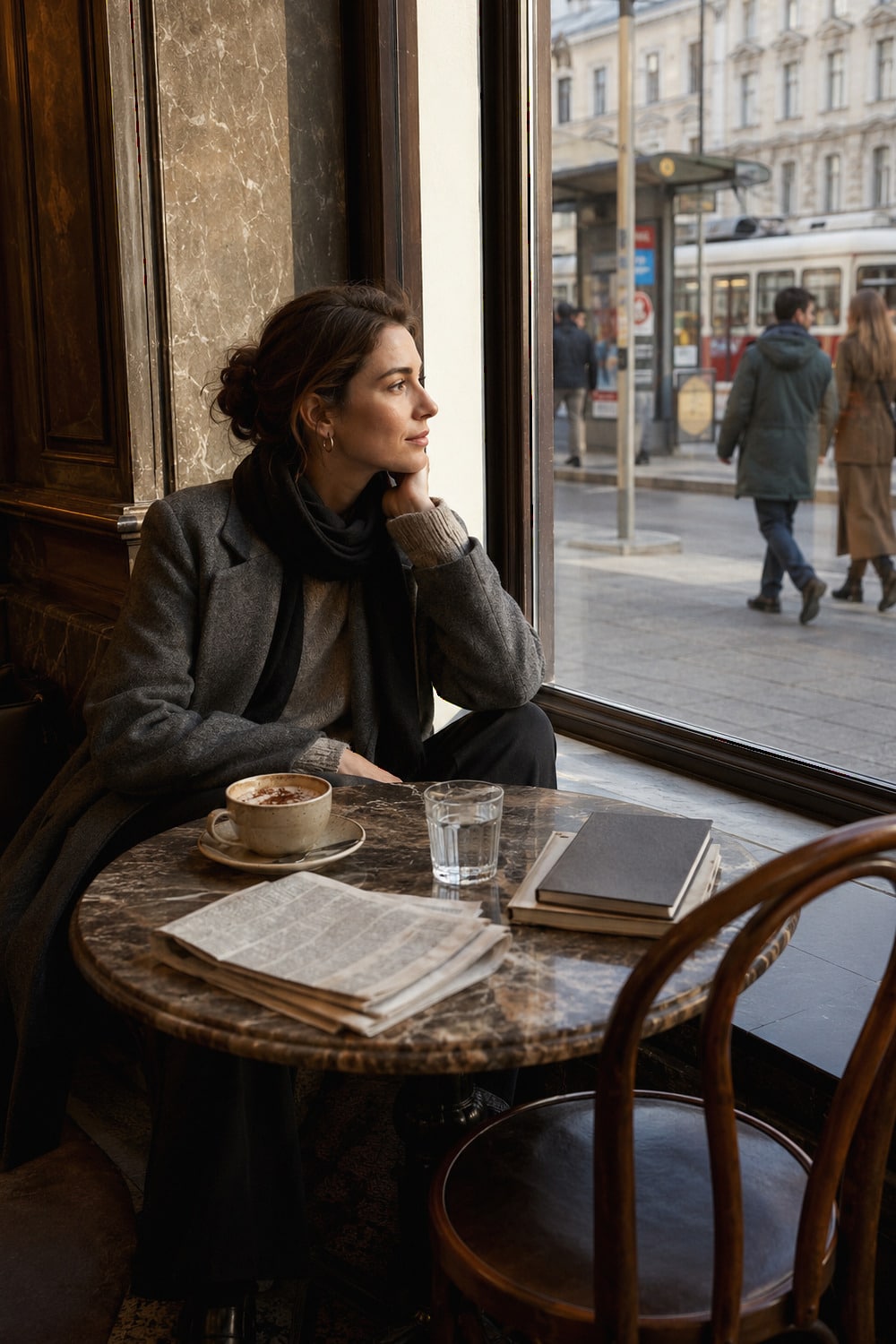
At a marble-topped table in Vienna, the Austrian women lifestyle frame stays deliberately narrow: a glass of water, a folded newspaper and a bentwood chair do more than decorate a coffee break. Together they shape a small piece of urban time: somewhere to read before a tram, meet after a museum visit, or sit alone without turning the pause into a rushed transaction.
That setting offers a focused way to discuss the Austrian women lifestyle subject without treating Vienna as a stand-in for the whole country. The scope here is the contemporary Vienna coffeehouse lifestyle, viewed through documented interiors, changing café formats, walkable connections and seasonal choices that keep a cultured day workable without theatrical imitation.
The useful question is practical: which parts of this city rhythm can travel responsibly? The answer lies in functions—durable furniture, a protected pause, clothes suited to walking and a route that joins everyday errands with cultural stops—not in copying heritage décor, ceremonial clothing or claims about how Austrian women live.
Key Takeaway: Vienna’s coffeehouse rhythm works as lifestyle inspiration when its useful functions—time, seating, reading and walkable connection—matter more than decorative imitation.
Austrian Women Lifestyle as a Focused Vienna City Study
A traditional Viennese coffeehouse is arranged for a longer stay than a counter-service stop; here, “Austrian women lifestyle” is a tightly scoped city subject rather than a claim about women across Austria. Marble tabletops give a cool, hard-wearing surface; alcoves and upholstered seats provide degrees of privacy; newspaper tables turn reading into part of the room. The Austrian Commission for UNESCO recorded these elements when Viennese coffeehouse culture entered Austria’s national intangible cultural heritage inventory in 2011, but Vienna coffeehouse culture is treated here as a defined social practice in the city, not as a description of every café or household across Austria.
The table’s first lesson is therefore spatial. A single drink can support several activities because the room permits them: reading, conversation, note-taking, waiting or watching the street. At home, the comparable move is not buying faux-imperial furniture. It is clearing one small surface near daylight, placing a comfortable chair at the correct height and keeping that surface free from storage. The function comes from available space and permission to stay, not from chandeliers or red velvet. In Vienna, that distinction matters because the grandest rooms can attract attention while the quieter value lies in how long the table remains usable after the first sip.
Vienna’s newspaper racks also suggest a useful boundary between attention and accumulation. A Zeitungshalter holds one paper visibly, while the rest remain on a shared table. A domestic version might be one current magazine, a pencil and a closed notebook, with chargers and unopened mail moved elsewhere. The arrangement borrows the coffeehouse’s reading function without pretending that a kitchen corner has become Café Central.
Marble Bentwood and the Work of Comfort
The familiar Thonet chair belongs in this story because its curved wood was engineered for repeat use, compact transport and easy placement around small tables. Vienna’s MAK has examined bentwood furniture as design history, and the chair’s continued presence in cafés shows how a recognisable silhouette can also be practical infrastructure. In this specific Vienna setting, Austrian women lifestyle does not promise vague refinement; it points instead to the relation between a light frame, a stable seat and a room that must be rearranged throughout the day.
That relation can guide a modest interior without reproducing a period set. Choose a chair light enough to move, a table that tolerates cups and handwriting, and lighting directed onto the page instead of merely glowing in the background. In a small flat, one well-proportioned chair beside a narrow table may perform better than a decorative cluster. The Vienna reference remains visible through function—bent material, compact scale, readable light—while the final result belongs to the room’s actual dimensions. A washable coaster, a hook for a bag and a nearby shelf can do more for repeated use than ornamental accessories copied from a historic interior.
Ringstrasse Rooms and Neighbourhood Coffee Bars
Vienna’s café landscape is not one preserved interior, and Austrian women lifestyle stays within this city setting. Along the Ringstrasse, long-established rooms use dark timber, mirrors, booths and formal service; Café Prückel is associated with a brighter mid-century redesign; smaller coffee bars in the seventh, ninth and second districts put more attention on roasting, preparation and concise modern interiors. These places do not form a neat old-versus-new contest. They serve different lengths of stay, different streets and different expectations around coffee.
For a reader shaping a daily routine, the useful distinction is between a room for dwelling and a stop for precision. A longer morning may suit a booth, newspaper and plated breakfast. A short gap near Schottentor or Praterstrasse may call for an espresso bar with a standing counter and a direct route back to work. A cultured rhythm is not automatically slow at every hour; Vienna’s contemporary café map includes both lingering and efficient stops.
This variation keeps Austrian women lifestyle within a capital-city case instead of turning its aesthetic into an Austrian rule. Coffeehouses in Vienna have a documented local history and material vocabulary, while cafés in Graz, Linz, Salzburg or smaller towns answer other streets, clientele and building stock. The headline’s Austrian frame should therefore be read through this precise Vienna case, with regional difference left open and assumptions withheld.
A practical adaptation can preserve that variation. Keep one place in your week for an unhurried drink and another for a brief, well-made coffee, then notice how seating, noise and route affect the choice. The point is not to rank traditional rooms above modern bars. It is to select the setting that fits the task, just as Vienna’s historic and third-wave venues occupy different parts of the same city day.
Walking Links the Interior to the City
In central Vienna, coffeehouses sit among tram stops, pedestrian streets, theatres, museums and university buildings, so the table can become one station within a longer city sequence. A pause near the Ringstrasse can fit between a tram stop and the Burgtheater; a table near the MuseumsQuartier can divide an exhibition visit from the walk home; a modern bar near the Danube Canal can anchor a shorter afternoon circuit. The route matters because the interior pause remains connected to the work of moving through the city.
Within the article’s focused city scope, Austrian women lifestyle becomes most transferable through this table-to-street sequence. Begin with a necessary journey, add one cultural stop that sits close to the route, then place the café where it solves a real need for rest, warmth, shade or conversation. The Vienna walking routine works because the places are connected by distance and timing. It avoids the artificial pressure to build an entire day around consumption.
Footwear and outerwear follow the route, not an image of city polish. Vienna’s stone pavements, tram platforms and changing seasons reward shoes that remain comfortable after several kilometres and layers that can be removed in a heated interior. Readers comparing calm design traditions may recognise related concerns in Swedish women lifestyle and Danish women lifestyle, while the Vienna version is tied to coffeehouse seating, public transport and frequent indoor-outdoor transitions.
Seasonal Layers Change the Pause
A winter coffeehouse pause in Vienna has a different job from a warm-weather stop. Cold pavements, heavy coats and early darkness make cloakroom space, dry footwear and a seat away from the door more valuable. A compact routine might pair a wool layer with a lighter knit that remains comfortable indoors, then place gloves and scarf together instead of spreading them across the table. The aim is not a prescribed look; it is an orderly transition from street temperature to heated room. A compact umbrella and a bag that can sit beside the chair also keep wet or bulky items away from the shared tabletop.
In warmer months, the same route may use shaded streets, a short outdoor table stop and a later walk along the canal or through a park. Fabrics can become lighter, but the decision still begins with function: sun exposure, distance, seating surface and the possibility of an evening breeze. In this city context, Austrian women lifestyle remains a Vienna-inspired wardrobe study shaped by repeated conditions—walking, trams, indoor culture and variable weather—not by a list of beige garments presented as national style.
An Evening Built Around One Cultural Anchor
Vienna’s coffeehouses have long sat near theatres, concert halls, museums and university buildings, which makes them useful before or after a cultural event. An evening does not need several prestigious bookings to feel connected. One exhibition, reading or performance can supply the anchor; the coffeehouse provides the interval where tickets are checked, impressions are written down or conversation continues without immediately moving to another venue.
At home, the equivalent becomes a sequence, not a decorative mood. Choose one recorded concert, catalogue essay or library book linked to a current interest, prepare a drink before beginning, and leave a short period afterward for notes. A small lamp, a ceramic cup and a cleared chair help because they support the activity. They should not be presented as Austrian symbols, and they do not need to resemble a grand café interior.
The same restraint applies to food. A slice of torte in a Viennese coffeehouse belongs to a particular menu, service setting and afternoon or evening pause. Reproducing an elaborate dessert is optional. A simple bakery item served on a plate can preserve the pacing of the break, while dietary needs, budget and local availability determine the choice. What travels is the deliberate interval around the food, not a claim to recreate Vienna at the kitchen table.
Final Thought
Austrian women lifestyle becomes useful in this narrow Vienna city study when the marble table, bentwood chair, newspaper, walking route and seasonal layer are read as working parts of a city day. Keep the pause connected to a real task and a real place; that is enough to carry the rhythm forward without turning Vienna into a costume or Austria into a single way of living.
References and Further Reading
- History of Viennese coffee house culture
- Viennese coffee house culture
- The Once and Future Coffeehouses of Vienna
- Thonet and Its Bestselling No. 14 Chair Get a Major Retrospective
- Why is Vienna’s coffee house culture so influential?
- My search for the perfect Sachertorte in Vienna
Related Reading