
Editorial Note: This lifestyle article is for general editorial inspiration only. It is not financial, medical, legal, travel, safety, or professional advice. Adapt every idea to your personal needs, budget, culture, location, and circumstances.
On a cool September morning, knit dress style can feel simple because the dress removes one decision from getting dressed, yet it creates another: how to keep a soft fabric from turning into an outfit with no clear edge. The answer usually appears before the accessories do, in the way the neckline sits, the hem falls and the dress holds its line once you start moving.
Knit dress style works best when softness has a visible boundary. A close rib can follow the body cleanly, while a roomier sweater knit may need a firmer shoe or an outer layer with a straighter cut. Neither approach is automatically smarter; the useful choice is the one that lets the dress look complete before you begin adding pieces around it.
This autumn, treat the dress as the centre of the silhouette instead of a blank base for extra styling. That shift makes belts, boots, coats and bags easier to judge because each addition has a specific job rather than simply making the outfit busier.
Key Takeaway: Knit dress style feels composed when the dress keeps a clear line of its own and the layers reinforce that line without adding bulk at every point.
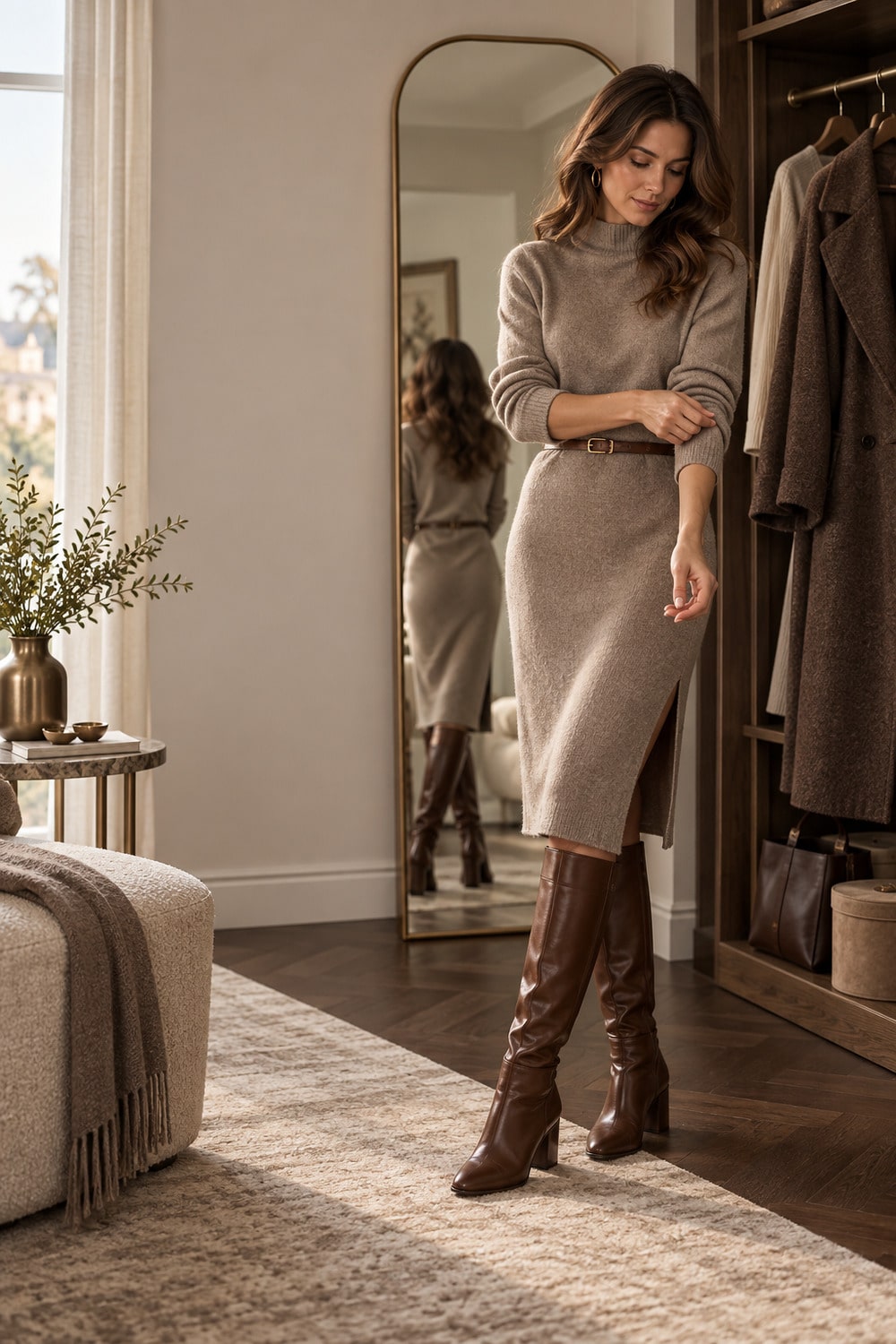
Knit Dress Style Starts With the Dress Itself
Look at the dress on its own first. If the neckline keeps its position, the shoulder line sits where you expect it to and the hem hangs without pulling to one side, the dress already has enough visual order to carry simple styling. If several of those lines collapse at once, a belt or blazer may disguise the problem in a mirror but can make the fabric feel more crowded through a full day of wear.
Texture changes the decision. Fine ribs create many narrow vertical lines, so they often need very little decoration. Chunkier cable or brushed knits already bring stronger surface detail; in sweater dress outfits, a smooth bag and plain boot give that texture room to register without asking a necklace, scarf and belt to compete with it.
A useful fitting check is to sit, walk and reach before deciding that a dress needs “more shape.” Some knits look controlled while standing and shift noticeably once the body moves. Styling should respond to the dress you actually wear in motion, not the still version that exists for a few seconds in front of a mirror.
Length Decides Where the Outfit Needs Weight
Hem length changes the balance between the dress and the shoe, which is why knit dress style depends on where that line meets the footwear. A mini leaves more leg visible, so a tall boot can give the lower half enough visual weight. With a midi, watch the gap between hem and boot shaft: a deliberate stretch of leg or a clean overlap usually reads more clearly than a narrow strip that looks accidental. A long dress already creates a strong vertical line, so a lower-profile shoe can be enough.
Pale knits make those proportion choices especially easy to see because every break in the silhouette stands out. The soft tonal layering in ivory knit style is useful here: keep neighbouring shades close when you want the dress to feel continuous, then let one darker shoe or bag provide the anchor.
Belting Is a Fit Decision Not a Default
Before reaching for a belt, pinch a small amount of fabric at the side of the waist. If the knit gathers into a thick roll, a belt is likely to create more bunching than definition. If the fabric folds into a flatter pleat, a narrow or medium-width belt can mark the waist without fighting the dress. This quick check is more useful than assuming every straight knit needs to be cinched.
Placement matters as much as width. A belt at the natural waist shortens the visual bodice and can make a midi feel more compact; sitting slightly lower keeps a relaxed line but may work better only when the dress has enough length to absorb it. When the dress already has shaping through ribs, darts or a defined waistband, leaving that construction visible is often the cleaner choice.
A Knit Dress Needs a Coat That Still Works Open
Outerwear should make sense while it is on and leave a complete outfit when it comes off, so knit dress style needs the coat to support rather than replace the dress’s line. Try the coat open before you judge the pairing. If the coat hem cuts across the widest or most detailed part of the dress, the two silhouettes can compete; a longer coat that passes the dress’s main waist detail often creates a calmer frame.
On damp transitional days, autumn layering can borrow the practical proportions in classic trench coat style for knit dresses. A trench can give a soft dress a crisp outer edge without trapping you in a heavy winter combination, which matters when the morning is cool but shops, trains or offices feel much warmer later.
That indoor and outdoor split is worth planning on purpose. If the dress only looks finished with the coat buttoned, the outfit loses its structure as soon as you take the coat off. A neckline with presence, a considered shoe and one useful accessory let the dress keep its shape visually through both parts of the day.
Boot Height Changes the Knit Dress Line
A knit dress with boots makes footwear part of the silhouette rather than a finishing detail. A slim ankle boot keeps a long knit light, while a taller or heavier boot can steady a shorter hem or a loose sweater shape. Keep accessories quieter when the knit itself is highly textured; smooth leather works well against ribs and cables, while suede bag style makes more sense when the dress is simple enough to absorb another matte surface. The test is not whether each item is attractive on its own, but whether the eye can still find the dress first.
Soft Tailoring Gives the Dress a Second Setting
A blazer can move a knit dress toward work or dinner without changing the dress itself, but the jacket should add a line the knit does not already have. A straighter shoulder is useful over a fluid midi; a cropped jacket can expose an existing waist detail; an oversized blazer works best when the dress underneath stays relatively narrow. The examples in soft tailoring style are most helpful when you use tailoring to clarify proportion, not to pile one loose shape over another.
This is also where a simple dress earns repeat wear. The same column knit can feel relaxed with flat boots and a coat, then more defined with a blazer and a smaller bag. Changing the frame around the dress is usually more effective than trying to make the knit itself perform several competing roles at once.
Final Thought
Knit dress style becomes easier to live with when the dress’s softness is allowed to stay visible and its boundaries are chosen with care. Start with the line the dress already creates, then use the hem, shoe and outer layer to keep that line readable from the first cool morning outside to the moment the coat comes off indoors.
References and Further Reading
- 18 Stylish Sweater Dress Outfit Formulas You’ll Want to Live in All Winter Long
- The Best Sweaterdress Outfits to Take You Through Fall With Ease
- A Cosy Knitted Dress Is The One-And-Done Answer To Autumn Dressing
- 6 Dress And Boot Pairings For Autumn
Related Reading